Wednesday, November 10, 2010

Ben Bernanke November 6, 2010 Remarks On QE2

On Saturday (November 6) Ben Bernanke took part in a panel discussion.  This was part of The Federal Reserve conference "A Return to Jekyll Island: The Origins, History, and Future of the Federal Reserve."

I found these comments, pertaining to QE2, to be highly notable:

Ben Bernanke:
"There is not really, in my mind, as much discontinuity as people think.  This sense out there, that quantitative easing or asset purchases, is some completely far removed, strange kind of thing and we have no idea what the hell is going to happen, and it's just an unanticipated, unpredictable policy - quite the contrary.  This is just monetary policy."
_____

A Special Note concerning our economic situation is found here
SPX at 1213.40 as this post is written

Tuesday, November 9, 2010

President Obama's November 7, 2010 "60 Minutes" Interview

On Sunday, President Obama was interviewed on "60 Minutes."

Here are four excerpts from the transcript that I found especially noteworthy.  I may comment upon them in the future as I find them, in various ways, to be (at least) somewhat provocative:

-

President Obama:  "And so, you know, the playing field now is a lot bigger and a lot more competitive than it used to be. And people rightly worry that if we don't make some fundamental fixes to the economy, that America may not be the preeminent economic power that it's been in the past.

Now, I have confidence that it will be. Because we still have the best universities. The best scientists. The most productive workers in the world. We've got the most entrepreneurial culture. And the strongest capital markets in the world. So, I'm still confident that America will see the 21st Century as the American century just as the 20th Century was. But that won't happen unless we make some big fundamental changes. And that's why even in the midst of crisis, we still spent time on things like education reform. Because if we don't deal with 'em now, we're gonna fall behind."

also:

"I think that the way to think about it is the dangers of a second big recession are now much reduced. The danger of us tipping into a great depression, I think most economists would say, is not there on the horizon."

also:

President Obama:  "I think we have to make sure that people understand and business understands that my overarching philosophy is not one in which we have constantly increasing government intervention."

also:

President Obama:  "And especially an economy this big, there are limited tools to encourage the kind of job growth that we need. But I have fundamental confidence in this country. I am constantly reminded that we have been through worse times than these, and we've always come out on top. And I'm positive that the same thing is gonna happen this time.

You know, there are gonna be setbacks, and we may take two steps forward and one step back, but the trajectory of this country is always positive. And that's something that that prevents me from getting too discouraged."
_____

A Special Note concerning our economic situation is found here
SPX at 1222.70 as this post is written

Monday, November 8, 2010

3 Critical Unemployment Charts - November 2010

As I have commented previously, as in the October 6, 2009 post, in my opinion the official methodologies used to measure the various job loss and unemployment statistics do not provide an accurate depiction.

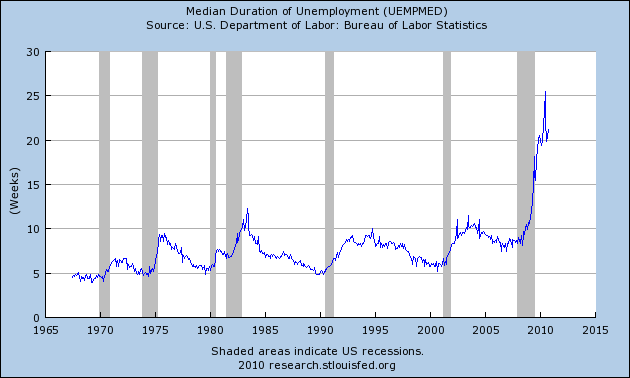
However, even if one chooses to look at the official statistics, the following charts provide an interesting (and disconcerting) long-term perspective of certain aspects of the officially-stated  employment situation.

The first two charts are from the St. Louis Fed site.  Here is the Median Duration of Unemployment:

(click on charts to enlarge images)(charts updated through 11-5-10)


-

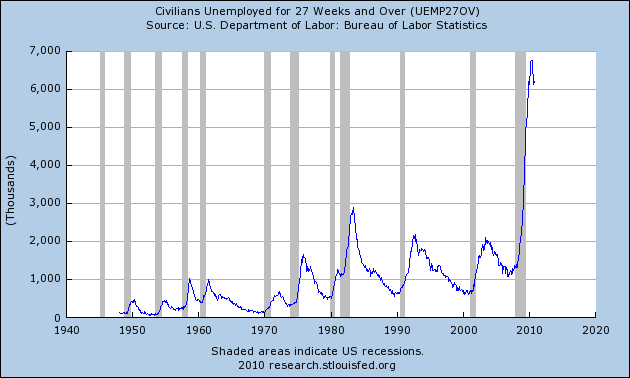
Here is the chart for Unemployed 27 Weeks and Over:


-

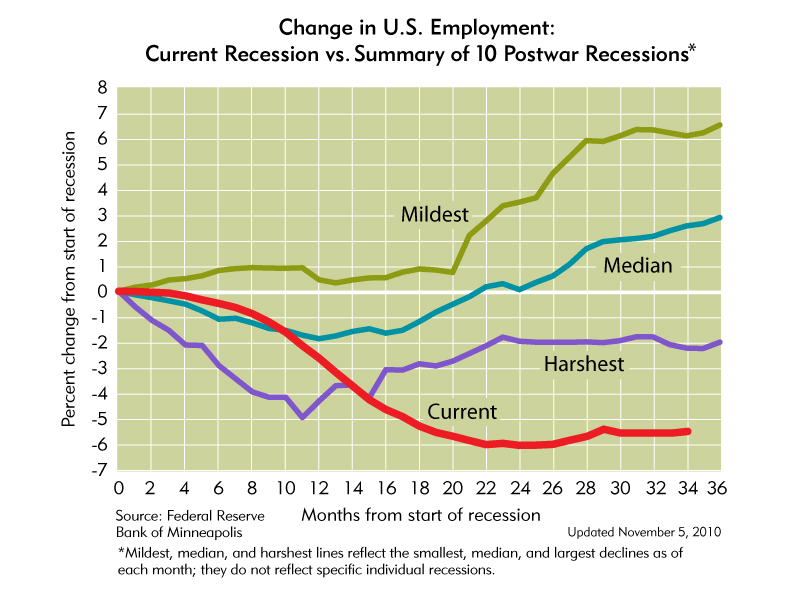
Lastly, a chart from the Minneapolis Federal Reserve site.  This shows the employment situation vs. that of previous recessions (as characterized by severity):


As depicted by these charts, our unemployment problem is severe.  Unfortunately, there do not appear to be any “easy” solutions.

In July 2009 I wrote a series of five blog posts titled “Why Aren’t Companies Hiring?”, which discusses various aspects of the topic, many of which lack recognition.

A Special Note concerning our economic situation is found here
SPX at 1222.70 as this post is written
Friday, November 5, 2010

Ben Bernanke On QE2

Ben Bernanke wrote an op-ed in The Washington Post yesterday titled, "What the Fed did and why: supporting the recovery and sustaining price stability."

I could write very extensively about this piece as it is highly notable on several fronts.  For now, I will limit my comments.

My analysis indicates that the risks of QE lack recognition.  As well, the benefits appear highly overstated.  As such, we (as a nation) appear to have a mistaken understanding of the risk-reward ratio of large-scale QE.  This is especially problematical as I expect additional large-scale QE will be done in the future.  This belief is echoed by other prominent parties.

What I find interesting about Bernanke's (and other Fed members') comments about QE is that they seem very limited in discussing risks of QE.  This begs the question as to whether Fed members don't think there is much risk in QE.  From what I have seen, the main risk Fed members have discussed is money supply issues / future inflation as well as the ability to gracefully (i.e. non-disruptively) exit such QE efforts.  Bernanke briefly mentions both of these items in his above-mentioned Washington Post op-ed.

However, I view those risks as being only two among a multitude of others.  As I wrote in the August 13 post, "There are an array of risks embedded in such QE efforts."  In that post I discuss QE risks to the U.S. Dollar and QE's role in fostering asset bubbles.

Another risk that receives little recognition is the risks embedded in the ever-increasing size of the Fed's portfolio.   This is a very complex potential risk, entailing both large potential capital losses (driven in large part by rising interest rates) as well as other unintended (negative) consequences.  The potential capital losses aspect is well-documented in a Wall Street Journal editorial of today titled "High Rollers at the Fed."

Both of these risks, as well as the multitude others, will only grow in importance if, as I suspect, additional (over and above Wednesday's $600B announcement) large QE is performed in the future.

A Special Note concerning our economic situation is found here

SPX at 1222.43 as this post is written

Thursday, November 4, 2010

S&P500 Earnings Consensus For 2011

Barron's came out with its "Fall 2010 Big Money Poll" on November 1.

There are a variety of statistics and poll results in it that I found interesting.

Of special note is the S&P500 2011 profit consensus of respondents, at $91.11.

There seems to be a growing overall consensus that S&P500 Operating Earnings will be in the $90-$95/share range.  This has been seen in numerous sources, some of which have been featured in past blog posts.
_____

I post various economic forecasts because I believe they should be carefully monitored.  However, as those familiar with this blog are aware, I do not agree with many of the consensus estimates and much of the commentary in these forecast surveys.
_____

A Special Note concerning our economic situation is found here
SPX at 1197.96 as this post is written

Wednesday, November 3, 2010

Political Volatility - November 2010

The results of yesterday's elections further solidify the trend of increasing political volatility.  Survey results indicate that much of this volatility has been driven by widespread dissatisfaction concerning the economic situation.

While this volatility has been recognized, many of its implications have lacked recognition.

On January 25, 2010 I wrote a post titled "Political Volatility." This post discusses other implications, particularly economic, of this political volatility.

Also of (increasing) relevance is an article I wrote in December 2008 titled "President Obama's Greatest Challenge." (listed as the fourth article in the Directory of Articles)

A Special Note concerning our economic situation is found here
SPX at 1193.57 as this post is written

Tuesday, November 2, 2010

Quantitative Easing - Varied Thoughts

There has been an immense amount of material written about additional Quantitative Easing (QE2).

Here are some of the works that I have found among the most interesting (although I don't necessarily agree with what is being said):

"Guidelines for Global Economic Policymaking," (pdf) Gregory Hess, Shadow Open Market Committee, October 12, 2010

Investment Outlook, November 2010, Bill Gross

"Night of the Living Fed," (pdf) Jeremy Grantham, GMO, October 2010

"What's Ahead for the Fed," Roubini Global Economics, October 27, 2010

excerpted material, Contrary Investor, October 14, 2010 commentary
-
As for my own thoughts on the issue, I have written about QE2 directly in the August 13 post, and have written extensively about interventions in various posts.  As well, two articles  focus on interventions, "Intervention's Potential Blindspots" as well as "My Overall Thoughts On The Bailouts, Stimulus Measures, and Interventions." (links for these two articles are found in "Directory of Articles")
_____
A Special Note concerning our economic situation is found here
SPX at 1193.59 as this post is written

Monday, November 1, 2010

Recession Measures - Updated

On April 21 I wrote a post titled "Recession Measures - Two Charts."

That post referenced an April 12  CalculatedRisk blog post titled “Recession Measures.” In it, Bill discussed key measures that the NBER uses to determine recoveries, and posted four charts.

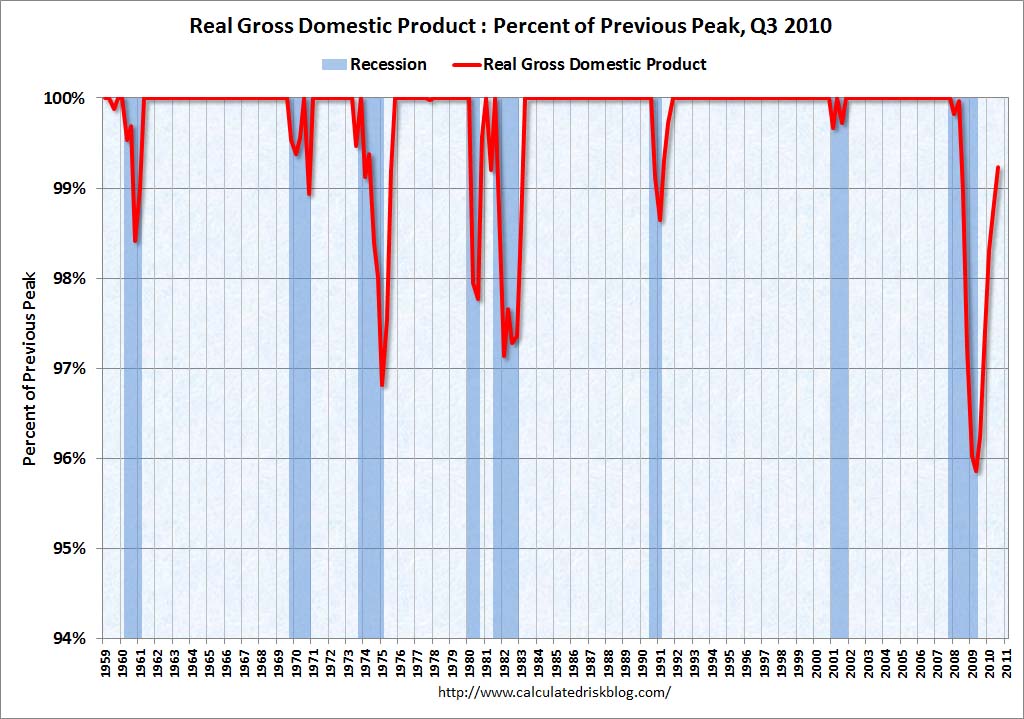
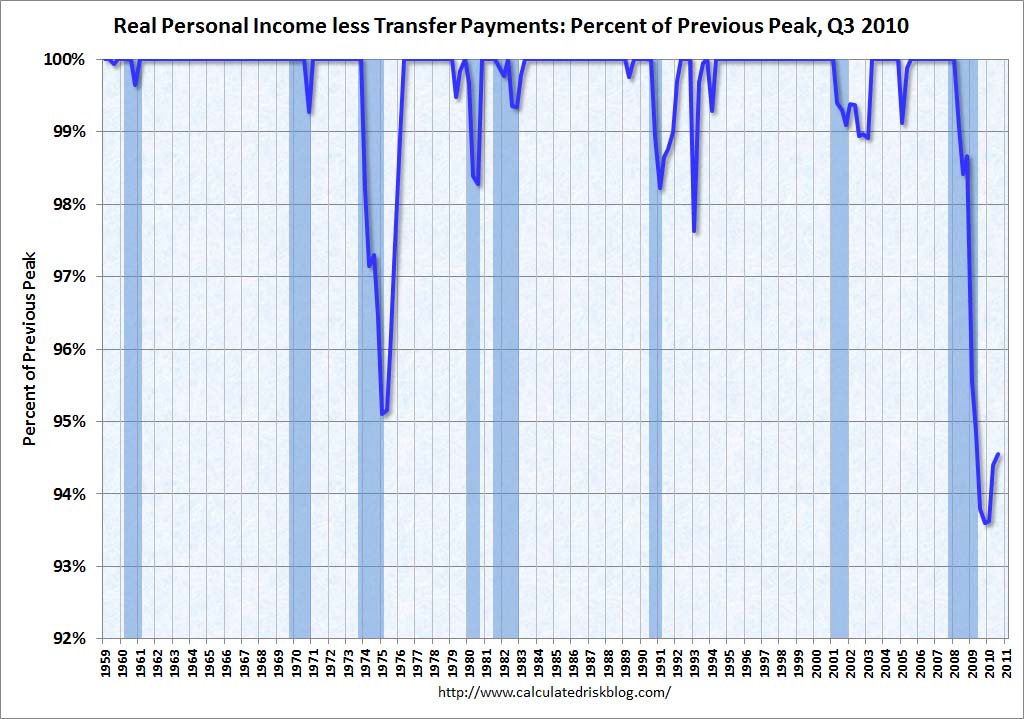
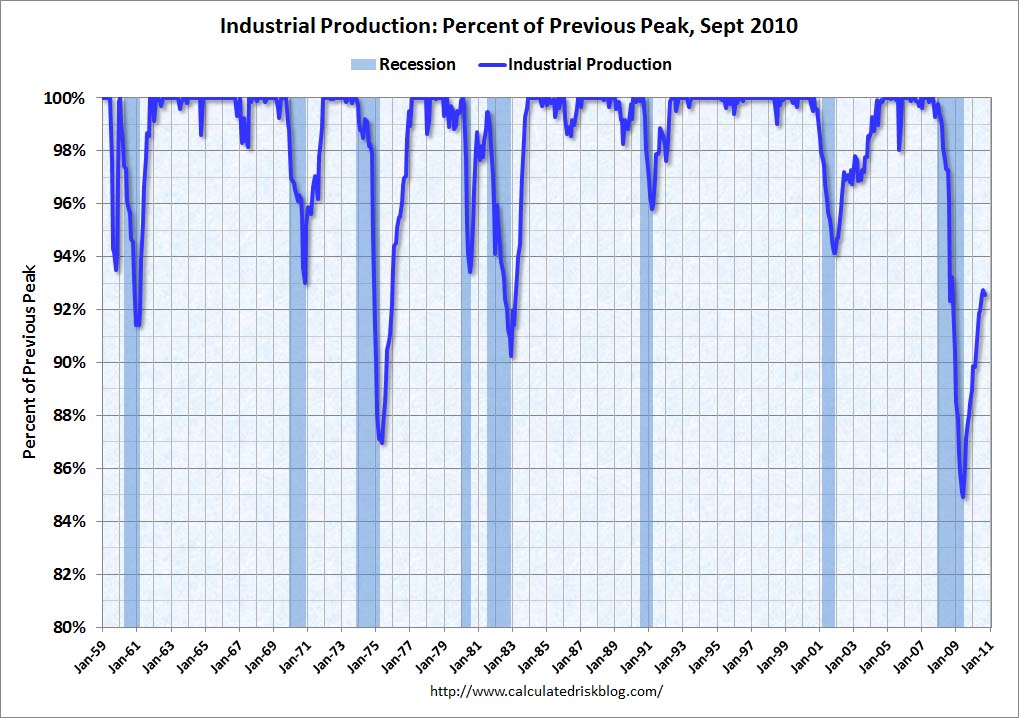
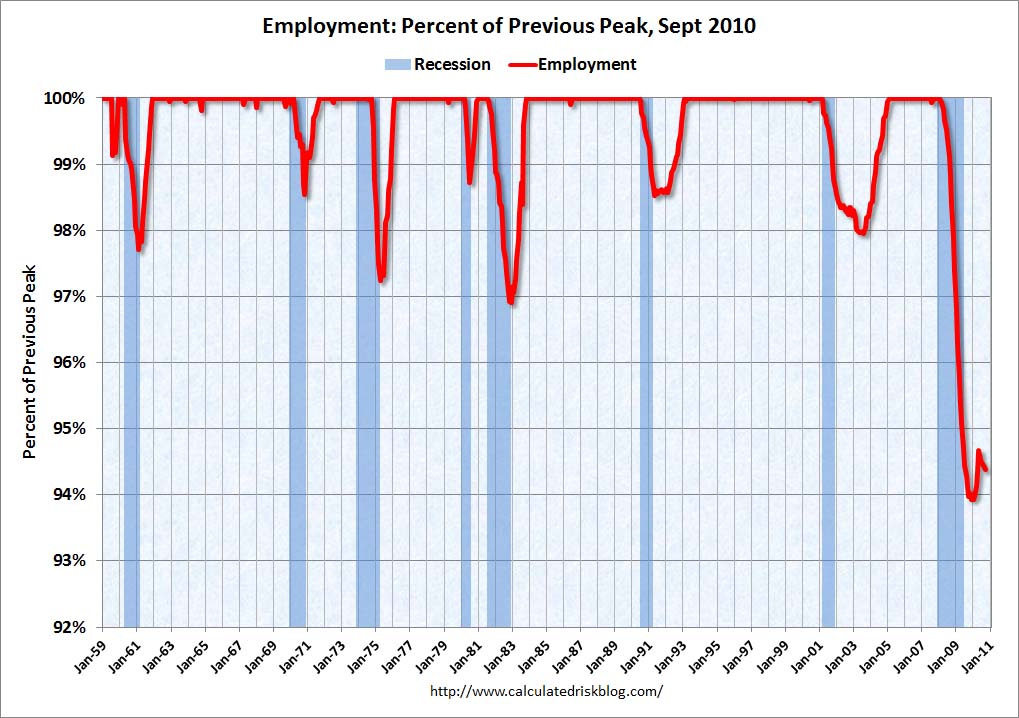
Here are those charts, updated in his October 29 post.  The charts are constructed in a fashion different than most - in a "percent of peak" fashion.  As defined, "The following graphs are all constructed as a percent of the peak in each indicator. This shows when the indicator has bottomed - and when the indicator has returned to the level of the previous peak. If the indicator is at a new peak, the value is 100%."  Periods of recession, as defined by the NBER, are shown as blue bars.

Here are the four charts: (click on images to enlarge)

Real Gross Domestic Product, still 0.8% below the pre-recession peak:


-

Real Personal Income Less Transfer Payments, still 5.5% below the pre-recession peak:


-

Industrial Production, still 7.5% below the pre-recession peak:


-

Payroll Employment, still 5.6% below the pre-recession peak:


_____

A Special Note concerning our economic situation is found here
SPX at 1183.26 as this post is written