Showing posts with label pricing. Show all posts

Monday, March 4, 2013

Issues Regarding Product "Affordability"


"Affordability" of products and services, both now and in the future, is an issue that seems to lack recognition, for a variety of reasons including aggregate U.S. income trends.

One example of this was highlighted on Wednesday, and was seen in a CNBC article titled "New Cars Increasingly Out of Reach for Many Americans" that discusses the affordability of new cars given median family incomes.  The article states that the average price of a new vehicle in 2012 was $30,500, and discusses this figure in relation to incomes.

Seemingly supporting the general concept that new vehicles may be unaffordable for many is that the average age of cars and light trucks in operation in the U.S. reached 11.2 years in 2012, according to Polk.

While affordability (by purchasers) can be difficult to define, and can fluctuate significantly over time, there are many indications that affordability constraints and related pricing issues are significant issues for many companies.

While it is of course difficult to generalize across all firms and industries due to their various characteristics, the following questions with regard to affordability appear to be among those of primary significance:
  • What is an affordable product?  Can affordability be estimated or measured?
  • Can a product or service be somewhat affordable?
  • What are the main drivers of product affordability, or lack thereof?
  • If a company has a product that is, or will soon become unaffordable, can the company successfully adapt?  How might this be done?
  • Are (purported) solutions to unaffordable product offerings viable from a longer-term perspective?  (i.e. by implementing such solutions, will such implementation cause additional problems?)
  • If a company finds itself with an unaffordable product, will this status be transitory or lasting?
  • Can high degrees of product "value" (at least partially) offset an otherwise unaffordable product?
Of course, there are many other questions as well.  One issue that I mentioned in a September 7, 2010 post ("Premium Pricing Strategies And The Economy") also seems very relevant:
...are products and services now considered “staples” (i.e. necessary in nature) changing to more “discretionary” in nature?  How will this impact firms?
In my opinion such affordability issues will increase given various economic dynamics, and become a primary challenge in corporate strategy and management.  This challenge will (very) likely prove to be especially outsized for a variety of reasons.
_____

The Special Note summarizes my overall thoughts about our economic situation

SPX at 1514.87 as this post is written

Tuesday, January 24, 2012

PPI,CPI & Profit Margin Trends – January 2012 Update


In various past posts I have written of the challenges businesses face in pricing, given today’s economic environment.  One aspect that I mentioned in the December 16, 2010 and April 25, 2011 posts was how the PPI (Producer Price Index) growth was significantly outpacing that of the CPI.

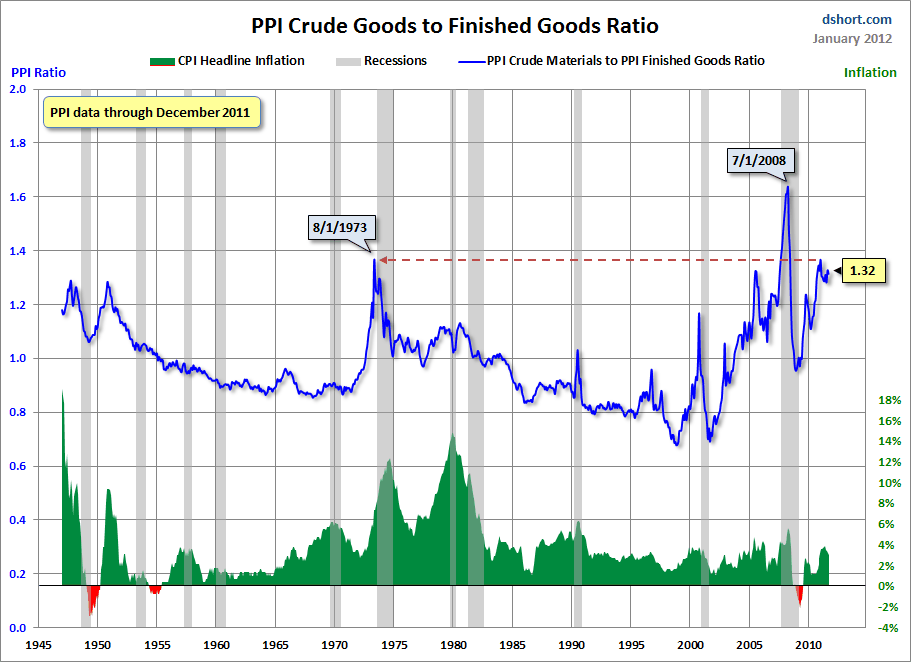
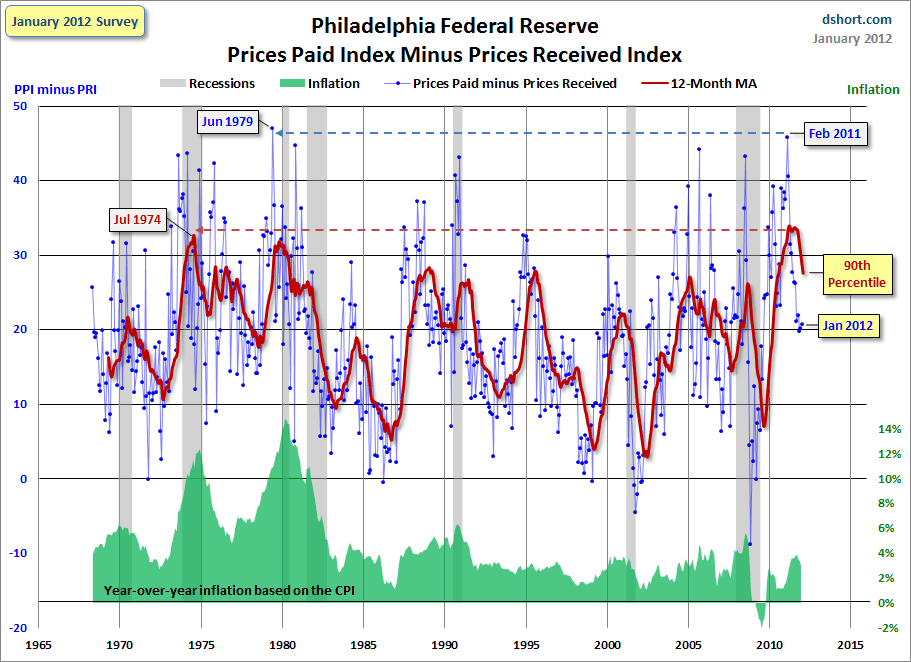
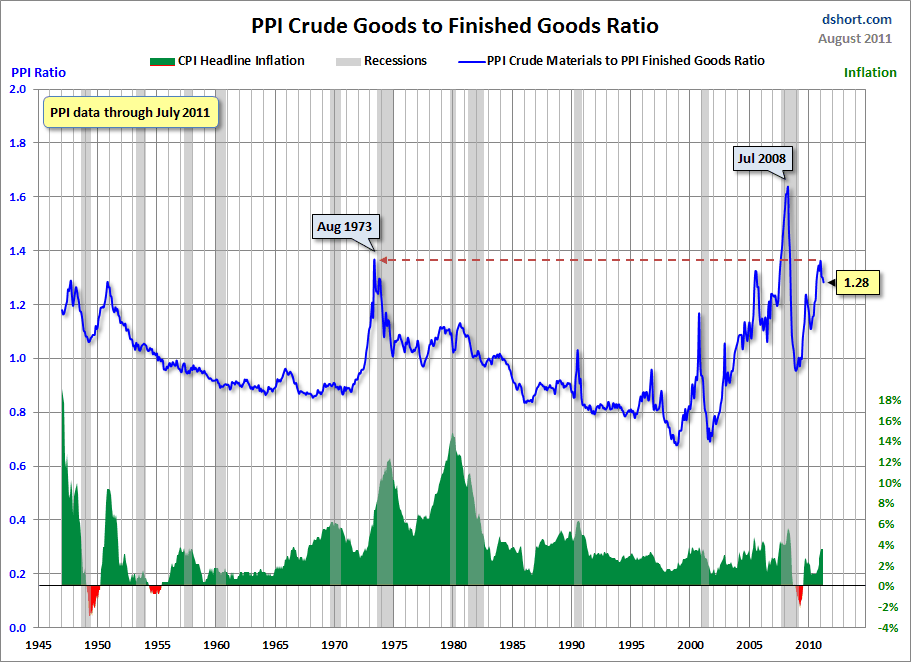
Since those posts, this PPI-CPI growth rate issue has remained notable.  Doug Short, on his blog, has posted a few interesting charts illustrating this concept from a long-term historical viewpoint.  Both of the charts shown below are from his January 20, 2012 post titled “Profit Margin Squeeze:  New Update.”

First, here is a chart that shows the ratio, in the PPI, of Crude Goods to Finished Goods. The CPI is plotted below, in green.  This situation, as depicted, is problematical for firms, and the overall economy, on a number of fronts:

(click on chart images to enlarge)


-

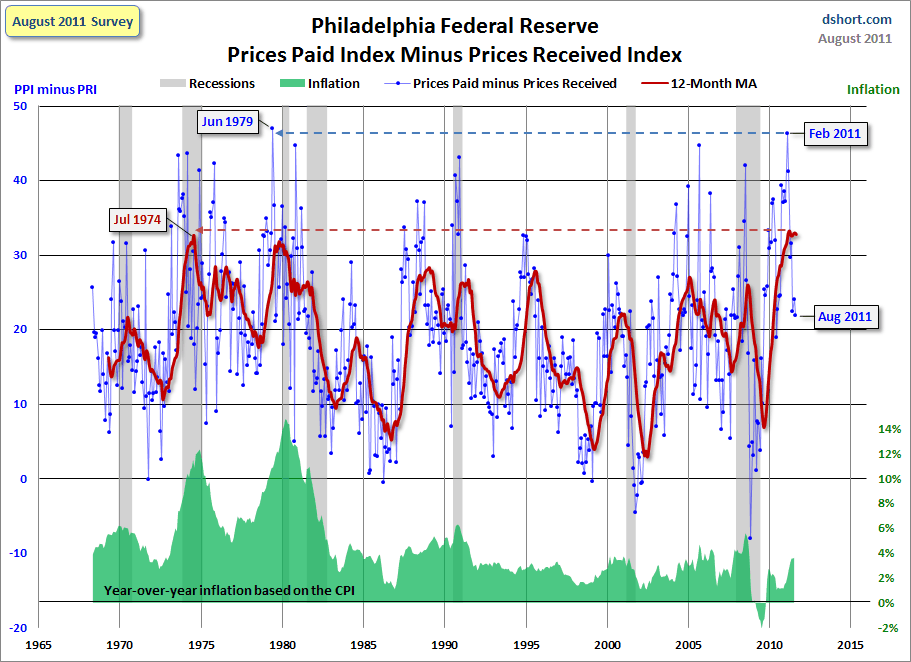
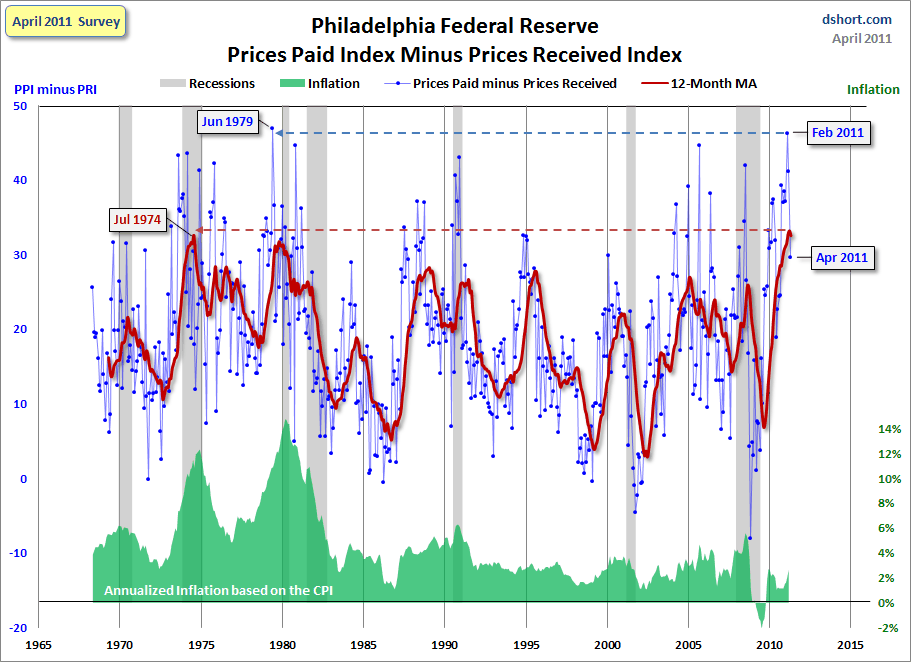
Second, a chart that shows data from the Philadelphia Federal Reserve regarding Prices Paid vs. Prices Received, with Inflation (CPI) and Recession periods also shown:


I believe that what this chart depicts is notable in a variety of ways.  As shown, we are experiencing a unique situation, and while the index level has recently subsided, we are near historical peaks for the 12-month moving average (MA) as shown.

I believe this data and its implications for businesses and the economy at large is of great concern.  Seeing how this situation resolves will be very interesting.  This is especially so given the vulnerability of the U.S. Dollar to a substantial decline, a topic that I have written extensively about.
_____

The Special Note summarizes my overall thoughts about our economic situation

SPX at 1316.00 as this post is written

Monday, October 24, 2011

PPI,CPI & Profit Margin Trends - October 2011 Update


In various past posts I have written of the challenges businesses face in pricing, given today’s economic environment.  One aspect that I mentioned in the April 25 2011 and December 16 2010 posts was how the PPI (Producer Price Index) growth was significantly outpacing that of the CPI.

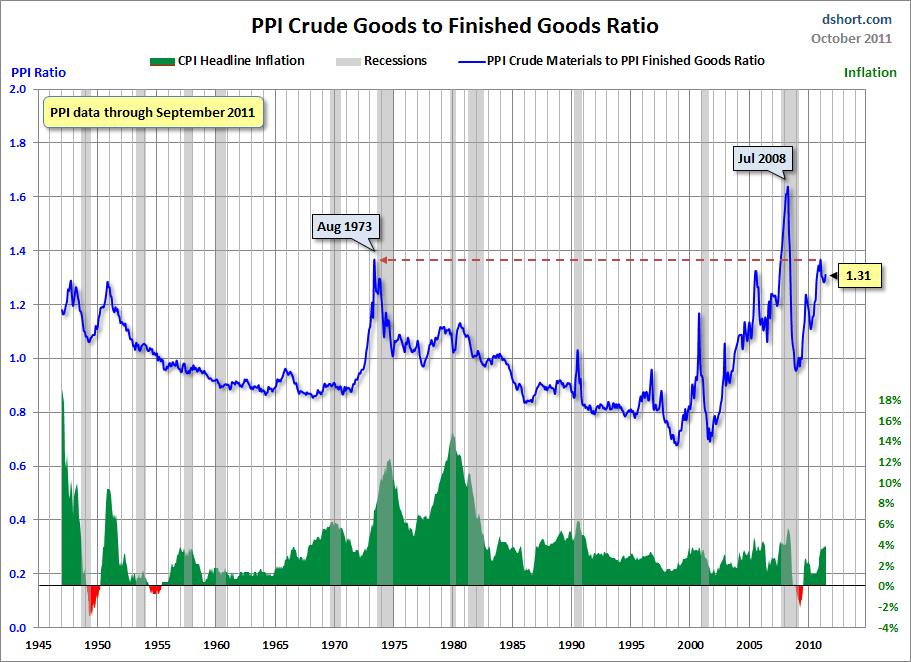
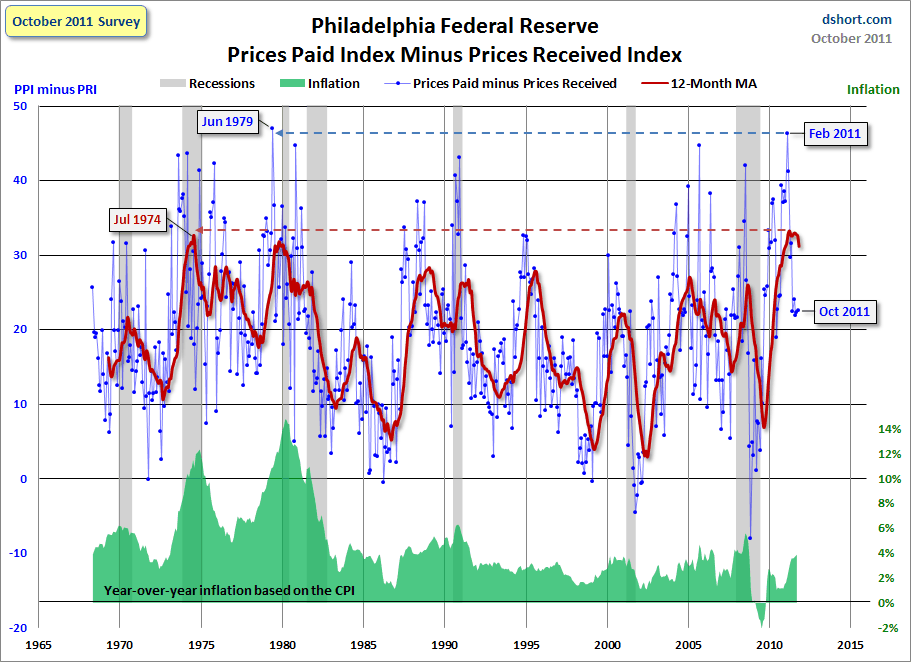
Since those posts, this PPI-CPI growth rate issue has remained notable.  Doug Short, on his blog, has posted a few interesting charts illustrating this concept from a long-term historical viewpoint.  Both of the charts shown below are from his October 20, 2011 post titled “Profit Margin Squeeze Remains a Challenge.”

First, here is a chart that shows the ratio, in the PPI, of Crude Goods to Finished Goods. The CPI is plotted below, in green.  This situation, as depicted, is problematical for firms, and the overall economy, on a number of fronts:

(click on chart images to enlarge)


-

Second, a chart that shows data from the Philadelphia Federal Reserve regarding Prices Paid vs. Prices Received, with Inflation (CPI) and Recession periods also shown:


I believe that what this chart depicts is notable in a variety of ways.  As shown, we are experiencing a unique situation, and while the index level has recently subsided, we are near historical peaks for the 12-month moving average (MA) as shown.

I believe this data and its implications for businesses and the economy at large is of great concern.  Seeing how this situation resolves will be very interesting.  This is especially so given the vulnerability of the U.S. Dollar to a substantial decline, a topic that I have written extensively about.
_____


The Special Note summarizes my overall thoughts about our economic situation


SPX at 1244.69 as this post is written

Friday, August 19, 2011

PPI, CPI & Profit Margin Trends


In various past posts I have written of the challenges businesses face in pricing, given today’s economic environment.  One aspect that I mentioned in the April 25 2011 and December 16 2010 posts was how the PPI (Producer Price Index) growth was significantly outpacing that of the CPI.

Since those posts, this PPI-CPI growth rate issue has remained notable.  Doug Short, on his blog, has posted a few interesting charts illustrating this concept from a long-term historical viewpoint.  Both of the charts shown below are from his August 18, 2011 post titled "Profit Margin Squeeze Continues to Challenge the Economy."

First, here is a chart that shows the ratio, in the PPI, of Crude Goods to Finished Goods. The CPI is plotted below, in green.  This situation, as depicted, is problematical for firms, and the overall economy, on a number of fronts:


(click on chart images to enlarge)


-

Second, a chart that shows data from the Philadelphia Federal Reserve regarding Prices Paid vs. Prices Received, with Inflation (CPI) and Recession periods also shown:


-

I believe that what this chart depicts is notable in a variety of ways.  As shown, we are experiencing a unique situation, and while the index level has recently subsided, we are near historical peaks for the 12-month MA as shown.

I believe this data and its implications for businesses and the economy at large is of great concern.  Seeing how this situation resolves will be very interesting.  This is especially so given the vulnerability of the U.S. Dollar to a substantial decline, a topic that I have written extensively about.
_____


The Special Note summarizes my overall thoughts about our economic situation


SPX at 1137.95 as this post is written

Monday, April 25, 2011

Rising Input Costs And The "Profit Margin Squeeze"

In various past posts I have written of the challenges businesses face in pricing, given today’s economic environment.  One aspect that I mentioned in the December 16 post was how the PPI (Producer Price Index) growth was significantly outpacing that of the CPI.

Since that December 16 post, this PPI-CPI growth rate issue has been exacerbated.  Doug Short, on his blog, has posted a few interesting charts illustrating this concept from a long-term historical viewpoint.  Both of the charts shown below are from his April 21, 2011 post titled "Profit Margin Squeeze and Inflation Risk:  A Slight Improvement."

First, here is a chart that shows the ratio, in the PPI, of Crude Goods to Finished Goods. The CPI is plotted below, in green.  This situation, as depicted, is problematical for firms, and the overall economy, on a number of fronts:

(click on chart images to enlarge)


-

Second, a chart that shows data from the Philadelphia Federal Reserve regarding Prices Paid vs. Prices Received, with Inflation (CPI) and Recession periods also shown:


-

I believe that what this chart depicts is notable in a variety of ways.  As shown, we are experiencing a unique situation, and are near historical peaks in both the index levels and the 12-month MA as shown.

I believe this data and its implications for businesses and the economy at large is of great concern.  Seeing how this situation resolves will be very interesting.  This is especially so given the vulnerability of the U.S. Dollar to a substantial decline, a topic that I have written extensively about.
_____

The Special Note summarizes my overall thoughts about our economic situation

SPX at 1337.38 as this post is written

Wednesday, February 23, 2011

The Changing Dynamics Underlying Profit Margins

In past posts I have written of the challenges businesses face in pricing, given today's economic environment.  One aspect that I mentioned in the December 16 post was how PPI (Producer Price Index) growth was significantly outpacing that of CPI.

Since that December 16 post, the PPI-CPI growth rate issue has been exacerbated.  Doug Short, on his blog, over the recent past has posted a few interesting charts illustrating this concept from a long-term historical viewpoint.

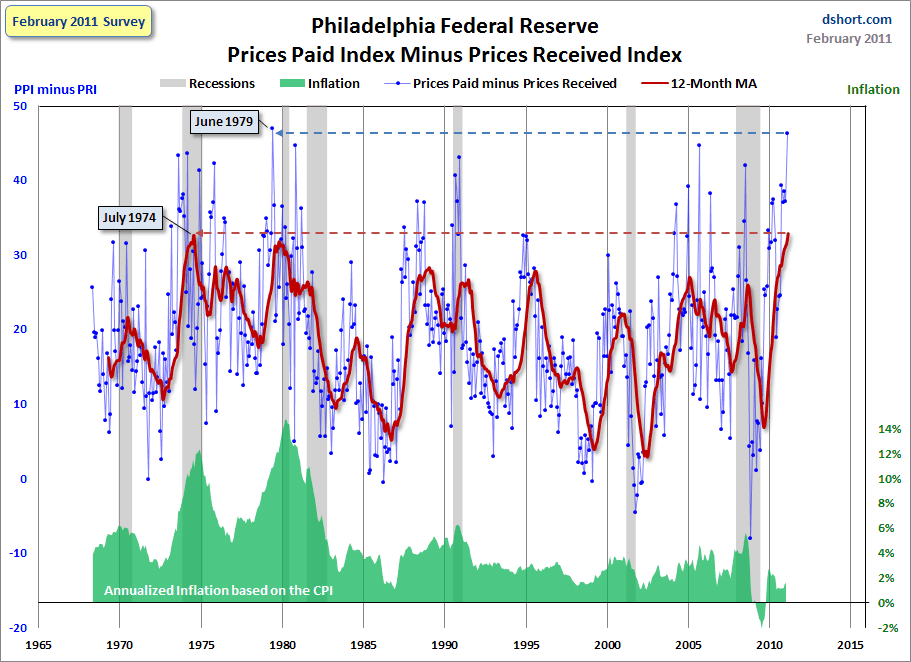
Below is a chart from his February 21 post, titled "Profit Margin Squeeze and Inflation Risk." It shows data from the Philadelphia Federal Reserve regarding Prices Paid vs. Prices Received, with Inflation (CPI) and Recession periods shown:


(click on chart to enlarge image)

I believe that what this chart depicts is notable in a variety of ways.  As shown, we are experiencing a unique situation on a variety of fronts, and are already at historical peaks in both the index levels and 12-month MA as shown.

I believe this data and its implications for businesses and the economy at large is of great concern, and as such monitoring such deserves rapt attention.  This is especially so given the vulnerability of the U.S. Dollar to a substantial decline, a topic that I have written extensively about.

A Special Note concerning our economic situation is found here

SPX at 1315.44 as this post is written

Thursday, December 16, 2010

PPI & CPI Trends

On Tuesday the November PPI figures were released, and they continue their recent trend of being significantly higher than the CPI figures.

Should this trend continue, it will of course likely have a significant impact on many companies' profitability.

I believe there are many reasons for why PPI growth is trending significantly higher than CPI.

As far as CPI is concerned, one factor that currently seems pronounced  is widespread discounting at the retail level.  This discounting has widespread future implications.  I have discussed other notable factors in the two Pricing posts of September 7 and April 23.

A Special Note concerning our economic situation is found here
SPX at 1236.63 as this post is written

Tuesday, September 7, 2010

Premium Pricing Strategies And The Economy

(This is my second blog post that solely discusses pricing issues.  My first was on April 23, 2010)

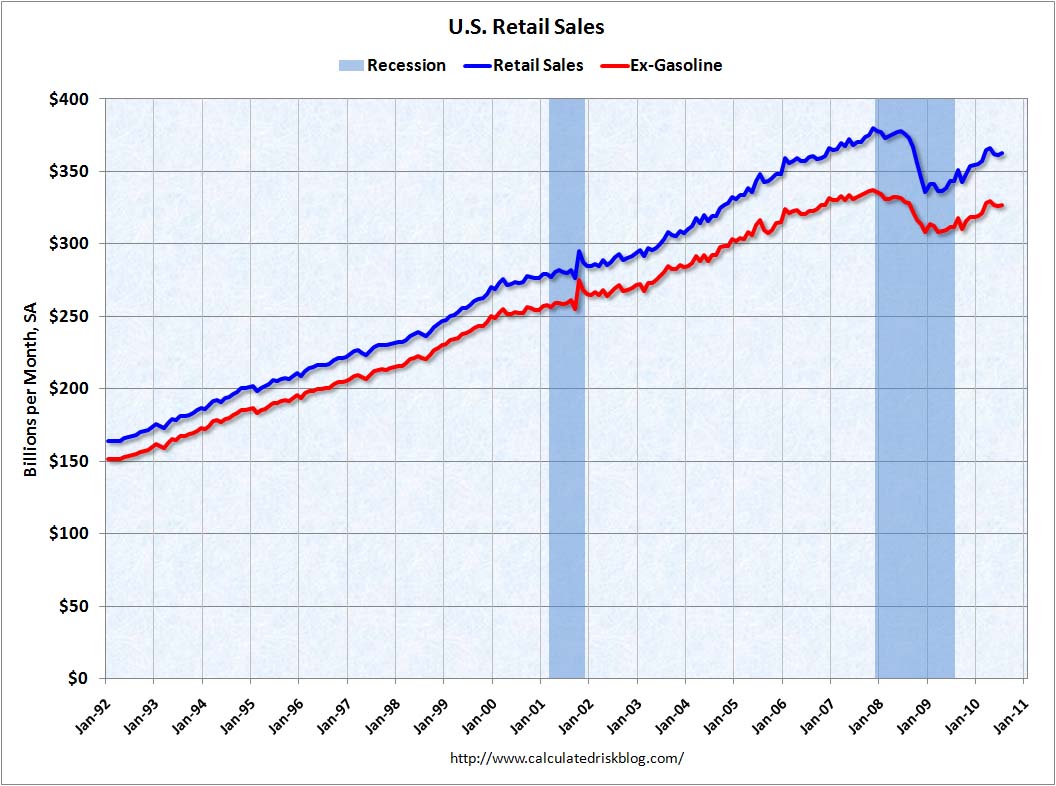
Firms in general have enjoyed the economic "tailwind" of rising sales for decades.  While this can be seen in a variety of measures, one of particular note is that of Retail Sales.  As seen in the following chart (from the CalculatedRisk blog of 8-13-10) Retail Sales have proven robust and (relatively) resilient with latter-2008 being the brief major exception:


(click on chart for larger image)

Despite this "tailwind", problems appear to be increasing especially in the area of pricing.  An August 19 Wall Street Journal article discussed pricing issues at P&G.  One part of the article was particularly noteworthy, discussing P&G's strategy of offering premium products:

"But the long recession and creaking recovery have undermined that strategy. Consumers might be willing to shell out for iPads, but their day-to-day spending reflects an entrenched frugality that often means leaving P&G's relatively expensive products on the shelf. Nearly two-thirds of U.S. consumers said they switched to a cheaper substitute for at least one basic household product, food or beverage in the past year, according to a Sanford Bernstein survey of 834 consumers. More than three-quarters said they believe less expensive products were as good as or better than those they replaced.

In response to the changing U.S. market, the company is doing the once unthinkable—slashing prices..."

P&G's situation does not seem unique, given the existence of widespread discounting and promotions despite resilient overall retail sales figures.  Given this dynamic, one question that arises is whether we are now starting to experience a (downward) revaluation in product differentiation?  In essence, is product differentiation generally losing its ability to attract sales at higher prices?  If so, the implications are immense, especially for those firms that are "Premium Pricers."

This issue is but one of many complex pricing issues now facing companies.  While it is of course difficult to generalize across all firms due to their various characteristics, the following five issues appear to be of primary significance:

First, how will those companies whose focus is offering premium products (and services) fare should the economy materially weaken (as I expect) from here?

Second, if one assumes that product differentiation is generally losing value (i.e. its ability to generate revenues at sufficiently higher prices), can "Premium Pricers" successfully adapt?  How might this be done?

Third, are products and services now considered "staples" (i.e. necessary in nature) changing to more "discretionary" in nature?  How will this impact firms?

Fourth, how will cost structures change should significant economic weakness reassert itself?

Fifth, are Pricing actions now being taken to attract sales (including discounting and promotions) undermining firms' future pricing power?  In other words, to what extent will current pricing actions undermine the future success of firms?

In the July 9 post, I wrote "I believe that many firms will continue to face very challenging conditions..."  This belief is based upon a number of factors.  However, firms' ability to successfully manage Pricing given the overall increasing complexity is a key reason for this belief.   On an "all things considered basis"  many firms do not appear to be successfully adapting to this new Pricing complexity.  This will prove especially problematical in a significantly weaker economic environment.


SPX at 1104.51 as this post is written

Friday, April 23, 2010

Pricing In Our Current Environment

Pricing is a very complex discipline even during periods of economic growth and stability. With the onset of increased economic uncertainty and volatility over the last few years, pricing's complexity has significantly grown.

Of course, it is impossible to characterize all firms as having the same pricing issues, as each industry and firm has a different set of circumstances. As well, any substantive discussion of pricing, especially in today's economic environment, would be exceedingly lengthy and complex. However, there appears to be enough commonality among past and future pricing issues as to allow for some general comments.

Many aspects of today's economic environment are negatively impacting pricing and profitability. Among these are outsized excess capacity and generally weak, if any, revenue growth. As well, many firms are encountering customers unwilling, and/or unable, to pay previously acceptable prices. Inventory issues (mentioned in the last post), forecasting complexities (discussed in this article), and recent steadily increasing commodity costs further complicate the situation. While many larger firms have been reporting strong profits, much of this profitability has been attained through cost-cutting and other related measures. As such, it is not necessarily profitability derived through "pricing power" and increased gross margins.

Many firms have responded to the current economic environment by reducing prices. Much of the heavy discounting and promotional activity appears rather indiscriminate in nature.

Although cutting prices is perhaps the easiest way to attain revenues, this tactic likely holds even greater danger now than in the past. Gauging the effectiveness of pricing decisions is often complex, especially when viewed in a strategic sense encompassing multiple time horizons. While pricing decisions made now can appear proper, continued economic volatility and uncertainty can serve to undermine the effectiveness of such pricing. In essence, what may appear to be a proper pricing decision now may radically change with changing economic conditions. The odds of inadvertently managing a firm into some type of adverse pricing situation (or trap) like a "price war" or other various profitability-depleting scenarios is increased with greater economic uncertainty as well as customers who are increasingly price sensitive.

Although the current economic environment holds significant peril for pricing and profitability, there is upside to the situation. Those firms that can effectively manage pricing in such an economic environment stand to gain significant competitive and strategic advantage across many different business functions - not to mention significantly increasing revenue and profitability when viewed against a scenario of ineffective pricing management.

SPX at 1208.67 as this post is written