Showing posts with label Consumer Metrics Institute. Show all posts

Thursday, October 7, 2010

Consumer Metrics Institute Readings: From Bad To Worse

This post highlights current readings from the Consumer Metrics Institute.  Previous posts solely concerning the Consumer Metrics Institute (CMI) can be found on August 23, July 27 and March 31;  as well CMI data is included in the monthly “Updates On Economic Indicators.”

Here are a couple of charts concerning the CMI's Daily Growth Index, as seen at Doug Short's site on 10/5/10:

(click on charts to enlarge images)
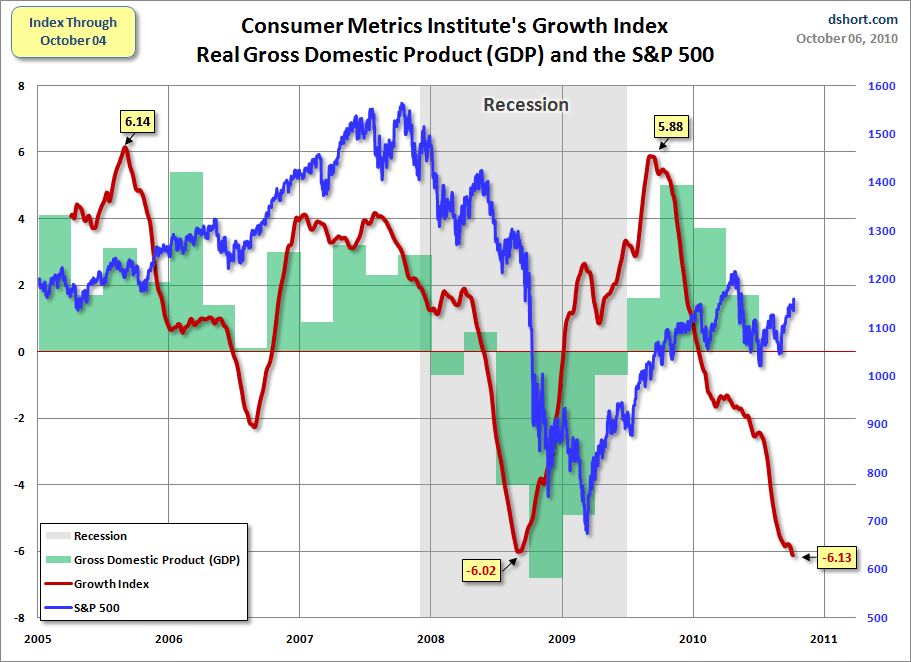

This chart shows the CMI Daily Growth Index vs. GDP and the S&P500.  I would like to highlight two notable items (among the many that I have commented upon in the aforementioned posts of August 23, July 27 and March 31).  First, as one can see the CMI Daily Growth Index is now (at -6.13) below the low experienced in 2008, which I view as highly notable and disconcerting, especially on an "all things considered" basis.  Second, another notable item is how the official (as defined by NBER) recession period, seen in gray, contrasts with the CMI's Daily Growth Index, especially after June 2009, the official end of the recession.


The second chart, as seen below, contrasts the Daily Growth Index's movements and durations from its 2008 and 2010 declines:
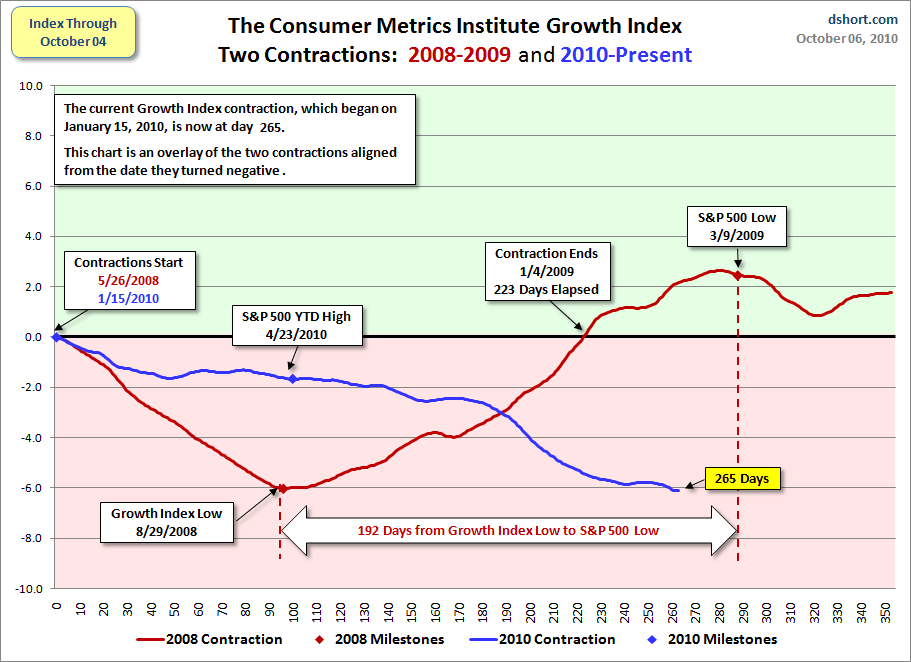


As seen in this chart, there are various disconcerting dynamics.  Perhaps most troubling is that the 2010 contraction appears significantly more pernicious than that of the 2008 decline  - with little if any indication that the current contraction will soon reverse.


SPX at 1160.75 as this post is written

Monday, August 23, 2010

Consumer Metrics Institute Data: Red Alert?

This post highlights current readings from the Consumer Metrics Institute.  Previous posts solely concerning the Consumer Metrics Institute can be found on July 27 and March 31; as well CMI data is included in the monthly "Updates On Economic Indicators."

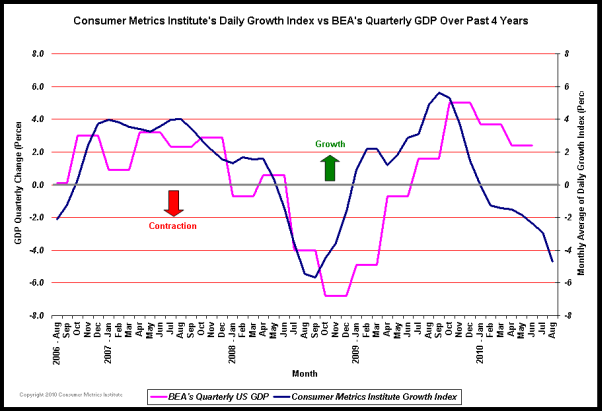
Here is a chart of CMI's Daily Growth Index: (click on chart images to enlarge)


As one can see, the Daily Growth Index is rapidly approaching the low of the 2008 reading; perhaps more importantly there seems to be no signs of abatement in its downward trajectory.  Also of great importance is the rift between its reading and that of Quarterly GDP.

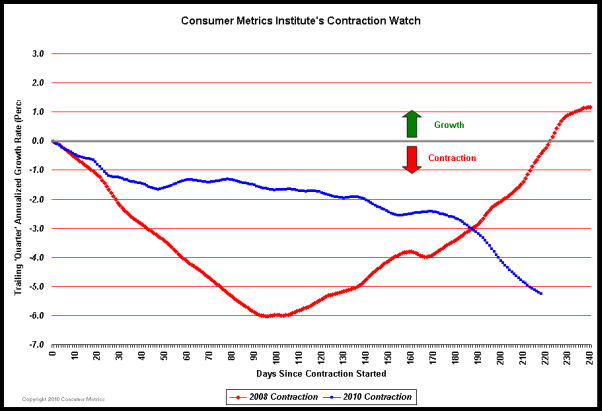
The second chart is CMI's Contraction Watch:


Here again, the readings are rather draconian, even when compared to the 2008 event.

Lastly, here is a chart from Doug Short's blog of 8-22-10.  It shows CMI's Growth Index vs. the S&P500 and GDP.  As one can see, if one believes in the efficacy of CMI's Daily Growth Index both the S&P500 and GDP seem destined for rather sharp downward trajectories:


Of course, before one can draw solid conclusions from CMI's data, one has to have a solid understanding of the methodologies used.  This is difficult with CMI's data as it is proprietary, and as such, it is much akin to other "black box" mechanisms where computations aren't disclosed.

As well, as CMI stated in their August 20 commentary, "Remember that our data only reflects consumer demand for discretionary durable goods."

However, from an "all-things-considered" basis, it would appear as if CMI's readings present the most negative forecasts among popularly published indicators.

As I stated in the July 27 post, "It should be very interesting to see how the CMI’s readings evolve as compared to actual economic activity…"


SPX at 1071.69 as this post is written

Tuesday, July 27, 2010

Consumer Metrics Institute's Readings

I have been following The Consumer Metrics Institute's work since March.  I have previously written two posts focusing on their work (both found on March 31), as well as included it in the monthly "Updates On Economic Indicators."

To briefly summarize, I find their work and methodologies very interesting, especially given that they appear quite different than other such measures that purport to depict/predict economic activity.

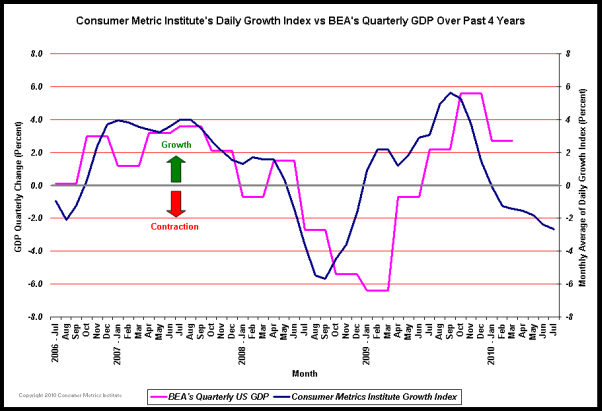
Here is one of their current charts, that of the Daily Growth Index:

(click on chart to enlarge image)


Given its proprietary methodologies and relatively limited history, it seems likely that varying interpretations of The Consumer Metrics Institute's data can be supported.   My interpretation of the chart is that the growing "rift" between GDP and the CMI's Consumer Growth Index is significant.  This begs the question as to which trend will prove accurate going forward; that of GDP growth around 3% (that which is the current consensus among economists for both full-year 2010 & 2011) or that of the CMI's Growth Index, which seems to be indicating some type of impending negative (perhaps significantly so) GDP growth rate?

Of course, one can argue that the CMI's growth rate can suddenly materially increase, which would likely support a positive GDP growth rate.   Of course, such a sudden increase is possible, but my "guess" (which is seemingly all that one can offer, given the proprietary nature of the data) is that such is unlikely.

Of further note is the CMI's "Contraction Watch" chart (not shown) and its implications.

Of course, the CMI's readings of weakening economic activity are not entirely unique.  ECRI's recent WLI Growth readings have generated much discussions lately given the WLI Growth's significant and rapid decline.

It should be very interesting to see how the CMI's readings evolve as compared to actual economic activity...

back to home

SPX at 1115.01 as this post is written

Wednesday, March 31, 2010

Consumer Metrics Institute Charts

Pursuant to the last post, here are some charts from The Consumer Metrics Institute that I find noteworthy:


As I indicated in the last post, I plan on including updated information from The Consumer Metrics Institute in my frequent updates of economic indicators...


SPX at 1170.51 as this post is written

The Consumer Metrics Institute

In the previous blog post I wrote of the issues and implications regarding the current economic growth rate.

There are a variety of sources and methods one may use in trying to gauge current and future economic growth. In this blog I frequently highlight and discuss many I feel are prominent and/or noteworthy. However, I am constantly searching for new sources as I feel that many of the well established, existing indices and methodologies have inherent weaknesses. These weaknesses, in many cases, are being magnified and exacerbated in our current economic environment.

One source of forecasting economic trends that I have recently become aware of is called "The Consumer Metrics Institute." This site uses proprietary methodologies that appear quite disparate from those used by others. I'll probably comment more on these methodologies later; however, for those interested the FAQs section as well as various other pages on the site provide an overview.

Their methods are yielding statistics that I find most interesting, both with regard to our current economic condition, as well as those pre-dating the 3Q/4Q 2008 financial maelstrom and aftermath.

In aggregate, I interpret the data shown by The Consumer Metrics Institute to show that current economic growth is not as strong as widely depicted and believed. Based upon their data, I infer (based on this data) that the economy may be far more vulnerable to significant economic weakness than widely envisioned.

It is always hazardous to place too much reliance on one data source, especially when it comes to economic forecasting. As well, it is easy to view the non-confirming (vs. highly established economic forecasting sources and widely held economic expectations) nature of this Consumer Metrics Institute data with skepticism as it belies many underlying consensus beliefs and associated data sources.

However, I think this is a potentially very valuable source of information and I plan on monitoring it diligently. It will be included in my frequent updates of economic indicators.

In the next post I will display a few charts from the site that I find especially noteworthy...

SPX at 1171.80 as this post is written