Tuesday, June 24, 2025

S&P500 Price Projections – Livingston Survey June 2025

The June 2025 Livingston Survey published on June 24, 2025 contains, among its various forecasts, a S&P500 forecast.  It shows the following price forecast for the dates shown:

June 30, 2025 5850.0

Dec. 31, 2025 5801.7

June 30, 2026 6027.3

Dec. 31, 2026 6210.3

These figures represent the median value across the forecasters on the survey’s panel.

_____

I post various economic forecasts because I believe they should be carefully monitored.  However, as those familiar with this site are aware, I do not agree with many of the consensus estimates and much of the commentary in these forecast surveys.

_____

The Special Note summarizes my overall thoughts about our economic situation

SPX at 6097.00 as this post is written

Monday, June 23, 2025

The U.S. Economic Situation – June 23, 2025 Update

Perhaps the main reason that I write of our economic situation is that I continue to believe, based upon various analyses, that our economic situation is in many ways misunderstood.  While no one likes to contemplate a future rife with economic adversity, current and future economic problems must be properly recognized and rectified if high-quality, sustainable long-term economic vitality is to be realized.

There are an array of indications and other “warning signs” – many readily apparent – that current economic activity and financial market performance is accompanied by exceedingly perilous dynamics.

I have written extensively about this peril, including in the following:

“Building Financial Danger” (ongoing updates)

My analyses continues to indicate that the growing level of financial danger will lead to the next stock market crash that will also involve (as seen in 2008) various other markets as well.  Key attributes of this next crash is its outsized magnitude (when viewed from an ultra-long term historical perspective) and the resulting economic impact.  This next financial crash is of tremendous concern, as my analyses indicate it will lead to a Super Depression – i.e. an economy characterized by deeply embedded, highly complex, and difficult-to-solve problems.

For long-term reference purposes, here is a chart of the Dow Jones Industrial Average since 1900, depicted on a monthly basis using a LOG scale (updated through June 20, 2025 with a last value of 42,206.82):

(click on chart to enlarge image)(chart courtesy of StockCharts.com)

DJIA since 1900

_____

The Special Note summarizes my overall thoughts about our economic situation

SPX at 5969.83 as this post is written

Sunday, June 22, 2025

CEO Confidence Surveys 2Q 2025 – Notable Excerpts

On June 18, 2025, the Business Roundtable released its CEO Economic Outlook Survey for the 2nd Quarter of 2025.   Notable excerpts from this release, titled “Business Roundtable Economic Outlook Index Declines Further in Q2“:

Business Roundtable today released its Q2 2025 CEO Economic Outlook Survey, a composite index of CEO plans for capital spending and employment and expectations for sales over the next six months. 

The overall Index dropped by 15 points from last quarter to 69, well below its historic average of 83. The decline is the result of decreases in all three subindices, driven by a downward shift in CEO plans and expectations, most notably in the employment subindex.

On May 29, 2025, The Conference Board released the Q2 2025 Measure Of CEO Confidence.   The overall measure of CEO Confidence was at 34, down from the previous reading of 60. [note:  a reading of more than 50 points reflects more positive than negative responses]

Notable excerpts from this Press Release include:

“CEO Confidence collapsed in Q2 2025 after surging in Q1,” said Stephanie Guichard, Senior Economist, Global Indicators, The Conference Board. “All components of the Measure weakened into pessimism territory. CEOs’ views about current economic conditions led the plunge, registering the largest quarter-on-quarter decline in almost 50 years. Expectations for the future also plummeted, with more than half of CEOs now expecting conditions to worsen over the next six months, both for the economy overall and in their own industries. CEOs’ assessments of current conditions in their own industries—a measure not included in calculating the topline Confidence measure—also fell sharply in Q2. The vast majority of CEOs (83%) said they expect a recession in the next 12-18 months, nearly matching the percentage who feared recession in late 2022 and early 2023. The US–China trade deal announced on May 12 seems to have eased, but not removed, concerns about the future. CEOs responding before and after May 12 reported similar very negative views about the current state of the economy and their own industries. However, the CEOs who responded after May 12 tended to be somewhat less pessimistic about the future and fewer expected a deep recession.“

_____

Additional details can be seen in the sources mentioned above.

_____

I post various economic forecasts because I believe they should be carefully monitored.  However, as those familiar with this site are aware, I do not necessarily agree with many of the consensus estimates and much of the commentary in these forecast surveys.

_____

The Special Note summarizes my overall thoughts about our economic situation

SPX at 5967.84 as this post is written

Friday, June 20, 2025

Jerome Powell’s June 18, 2025 Press Conference – Notable Aspects

On Wednesday, June 18, 2025 FOMC Chair Jerome Powell gave his scheduled June 2025 FOMC Press Conference. (link of video and related materials)

Below are Jerome Powell’s comments I found most notable – although I don’t necessarily agree with them – in the order they appear in the transcript.  These comments are excerpted from the “Transcript of Chair Powell’s Press Conference“ (preliminary)(pdf) of June 18, 2025, with the accompanying “FOMC Statement” and “Summary of Economic Projections” (pdf) dated June 18, 2025.

Excerpts from Chair Powell’s opening comments:

Good afternoon.  My colleagues and I remain squarely focused on achieving our dual mandate goals of maximum employment and stable prices for the benefit of the American people.  Despite elevated uncertainty, the economy is in a solid position.  The unemployment rate remains low, and the labor market is at or near maximum employment.  Inflation has come down a great deal but has been running somewhat above our 2 percent longer run objective.

also:

Our monetary policy actions are guided by our dual mandate to promote maximum employment and stable prices for the American people.  At today’s meeting, the Committee decided to maintain the target range for the federal funds rate at 4-1/4 to 4-1/2 percent and to continue reducing the size of our balance sheet.  We will continue to determine the appropriate stance of monetary policy based on the incoming data, the evolving outlook, and the balance of risks.

Changes to trade, immigration, fiscal, and regulatory policies continue to evolve, and their effects on the economy remain uncertain.  The effects of tariffs will depend, among other things, on their ultimate level.  Expectations of that level, and thus of the related economic effects, reached a peak in April and have since declined.  Even so, increases in tariffs this year are likely to push up prices and weigh on economic activity.

Excerpts of Jerome Powell’s responses as indicated to various questions:

CHRIS RUGABER.  Thank you, Chris Rugaber at Associated Press. There is an argument out there in favor of cutting rates more immediately. Inflation has continued to cool and is back at roughly 2 percent, despite the tariffs. And I guess I also wanted to ask about cracks in the job market with gross hiring slowing, concentrated in just a few industries. We’ve seen some housing data, including this morning, that have been pretty weak. Do you see any concerns that the economy is weakening and that is a reason to cut rates going forward? 

CHAIR POWELL.  So we do, we do of course monitor all those things. I think if you look at the overall picture, what you’re seeing is 4.2 percent unemployment, and an economy that’s growing at a rate hard to know given the unusual flows in the first quarter, but it appears to be 1-1/2, 2 percent, maybe a little better than that. Sentiment has come up off of its very low levels. It’s still, it’s still depressed, so you can point to things, the housing market is a longer run problem, and also a short run problem. I don’t think it’s indicative of — basically situations, we have a longer run shortage of housing, and we also have high rates right now. I think the best thing we can do for the housing market is to restore price stability in a sustainable way and create a strong labor market, and that’s the best thing we can do for the housing market. You asked about the job market, again, look at labor force participation, look at wages, look at job creation. They’re all at healthy levels now. I would say you can see perhaps a very, very slow continued cooling, but nothing that’s troubling at this time. But we watch it very, very carefully. So overall, again, the current stance of monetary policy leaves us well-positioned to respond in a timely way to economic developments, for now, and we’ll be watching the data carefully. 

CHRIS RUGABER.  Well, and just quickly, on — given that there are concerns inflation will rise, but there is the alternate scenario that tariffs would create demand destruction and slow growth sufficiently and that would perhaps keep a bit of a lid on inflation. Do you see odds of that scenario, what kind of odds do you see of that scenario coming true, and how many months of cool inflation would you need to see before concluding that maybe that lower inflation scenario is taking place? 

CHAIR POWELL.  So, this is very much the conversation we had today and yesterday. There are many, many different scenarios, many combinations of scenarios, where inflation does or doesn’t prove out to be at the levels we think and where the labor market does or doesn’t soften. And I think what you see people doing is looking ahead at a time of very high uncertainty, and writing down what they think the most likely case is. No one holds these rate paths with a great deal of conviction, and everyone would agree that they’re all going to be data dependent. And you can make a case for — for any of the rate paths, I think, that you see in the SEP. And we do this once a quarter, it’s a hard thing to do, particularly at this time. But it does reflect — if you see somebody writing down a rate path that involves cuts, that’s them saying, yes, I think we will get to a place more likely than not, where cuts will be appropriate. And it could be — it could be a joint probability of a number of possible outcomes. Again, remember how much uncertainty we face though. 

also:

NEIL IRWIN. Thanks Chair Powell. Neil Irwin with Axios. There have been some cutbacks in economic statistics collection the last few weeks. Worries that long-running problems around funding and response rates may be getting worse. How much is this concern on your radar? How much confidence do you have that the gauges you’re watching to assess the economy are reliable right now? 

CHAIR POWELL. Two things, one, the data we get right now, we can do our jobs. I’m not concerned that we can’t do our jobs. That’s not the — that’s not the point. The point really is that we are starting to see layoffs and important gatherers of data are saying that they’re having to cut back on the size of their surveys. That’s going to lead to more volatility in the surveys. I think we should take a step back and from our standpoint, and I think the standpoint of businesses and governments and everyone, having really good data on the state of the economy at any given time is a huge public good. It helps — it doesn’t just help the Fed, it helps the government, it helps Congress, it helps the Executive Branch. More importantly really, it helps businesses. They need to know what’s going on in the economy. The United States has been a leader for many, many years in this whole project of measuring and understanding what’s happening in our very large and dynamic economy. And I hate to see, I hate to see us cutting back on that, because it is a real benefit to the general public that people in all kinds of jobs have the best possible understanding of what’s happening in the economy and hence, what’s likely to happen. It’s very hard to measure what’s going on in the U.S. economy if you read — there was a book called, well it’s really remarkable how many things you need to understand to estimate U.S. GDP, very, very difficult. And it’s so important that we get it right. I just would, I just would say it’s not a place to — I would want to keep investing in that for the good of the general public. 

_____

_____

The Special Note summarizes my overall thoughts about our economic situation

SPX at 5959.46 as this post is written

Wednesday, June 18, 2025

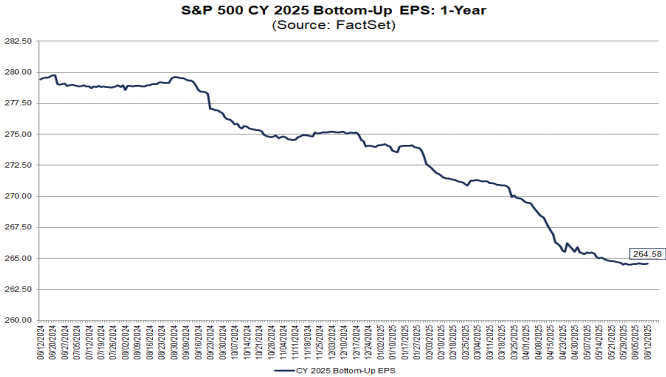
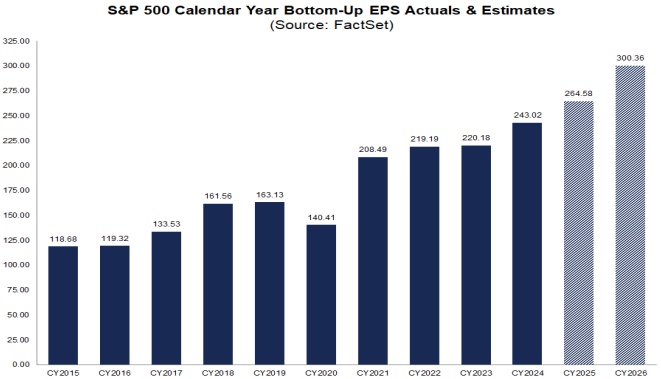
Trends Of S&P500 Earnings Forecasts

S&P500 earnings trends and estimates are a notably important topic, for a variety of reasons, at this point in time.

FactSet publishes a report titled “Earnings Insight” that contains a variety of information including the trends and expectations of S&P500 earnings.

For reference purposes, here are two charts as seen in the “Earnings Insight” report of June 13, 2025:

from page 26:

(click on charts to enlarge images)

S&P500 EPS

from page 27:

S&P500 EPS

_____

I post various economic forecasts because I believe they should be carefully monitored.  However, as those familiar with this site are aware, I do not agree with many of the consensus estimates and much of the commentary in these forecast surveys.

_____

The Special Note summarizes my overall thoughts about our economic situation

SPX at 5996.91 as this post is written


Monday, June 16, 2025

S&P500 EPS Forecasts For 2025-2027 As Of June 13, 2025

As many are aware, Refinitiv publishes earnings estimates for the S&P500.  (My other posts concerning S&P earnings estimates can be found under the S&P500 Earnings label)

The following estimates are from Exhibit 24 of the “S&P500 Earnings Scorecard” (pdf) of June 13, 2025, and represent an aggregation of individual S&P500 component “bottom up” analyst forecasts.  For reference, the Year 2014 value is $118.78/share; the Year 2015 value is $117.46/share; the Year 2016 value is $118.10/share; the Year 2017 value is $132.00/share; the Year 2018 value is $161.93/share; the Year 2019 value is $162.93/share; the Year 2020 value is $139.72/share; the year 2021 value is $208.12/share; the year 2022 value is $218.09/share; the year 2023 value is $221.36/share; and the year 2024 value is $242.73/share:

Year 2025 estimate:

$263.14/share

Year 2026 estimate:

$299.97/share

Year 2027 estimate:

$339.25/share

_____

I post various economic forecasts because I believe they should be carefully monitored.  However, as those familiar with this site are aware, I do not agree with many of the consensus estimates and much of the commentary in these forecast surveys.

_____

The Special Note summarizes my overall thoughts about our economic situation

SPX at 6033.11 as this post is written

Standard & Poor’s S&P500 EPS Estimates 2025 – 2026 – June 12, 2025

As many are aware, Standard & Poor’s publishes earnings estimates for the S&P500.  (My posts concerning their estimates can be found under the S&P500 Earnings label)

For reference purposes, the most current estimates are reflected below, and are as of June 12, 2025:

Year 2025 estimates add to the following:

-From a “bottom up” perspective, operating earnings of $255.76/share

-From a “bottom up” perspective, “as reported” earnings of $236.25/share

Year 2026 estimates add to the following:

-From a “bottom up” perspective, operating earnings of $296.06/share

-From a “bottom up” perspective, “as reported” earnings of $275.17/share

_____

I post various economic forecasts because I believe they should be carefully monitored.  However, as those familiar with this site are aware, I do not agree with many of the consensus estimates and much of the commentary in these forecast surveys.

_____

The Special Note summarizes my overall thoughts about our economic situation

SPX at 6033.11 as this post is written

Friday, June 13, 2025

Fannie Mae Home Price Expectations Survey (HPES) Q2 2025

On June 13, 2025, the Fannie Mae Q2 2025 Home Price Expectations Survey (HPES) results were released.  This survey is done on a quarterly basis.

Various Q2 2025 Fannie Mae Home Price Expectations Survey information is available, including the chart seen below:

U.S. Home Price Expectations

As one can see from the above chart, the average expectation is that the residential real estate market, as depicted by the Fannie Mae Home Price Index, will continually climb.

The detail of the survey is interesting.  Of the survey respondents, only two (of the displayed responses) forecasts a cumulative price decrease through 2029.

The Median Cumulative Home Price Appreciation for years 2025-2029 is seen as 3.40%, 6.60%, 10.44%, 14.70%, and 19.11%, respectively.

For a variety of reasons, I continue to believe that these forecasts will prove far too optimistic.

I have written extensively about the residential real estate situation.  For a variety of reasons, it is exceedingly complex.  While many people continue to have an optimistic view regarding future residential real estate prices, in my opinion such a view is unsupported on an “all things considered” basis.  Residential real estate is an exceedingly large asset bubble. As such, from these price levels there exists potential for a price decline of outsized magnitude. 

_____

The Special Note summarizes my overall thoughts about our economic situation

SPX at 5979.93 as this post is written