Showing posts with label intervention. Show all posts

Monday, June 26, 2023

The Real Fed Funds Rate And Its Significance

On January 9, 2017 I wrote a post titled “Low Interest Rates And The Formation Of Asset Bubbles.“  As discussed in that post – and for other reasons – the level of the Fed Funds rate – and whether its level is appropriate – has vast importance and far-reaching consequences with regard to many aspects of the economy and financial system.

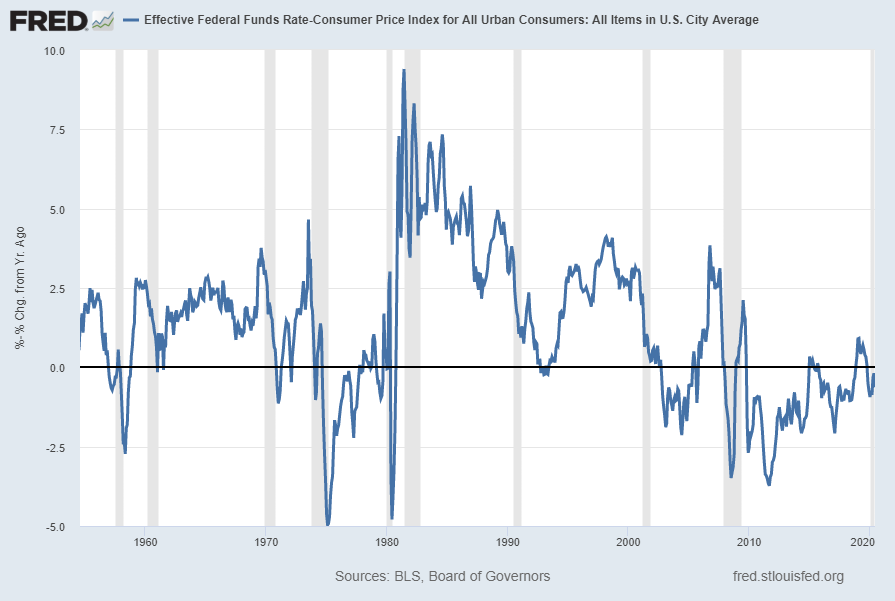
Along these lines, below is an updated long-term chart indicating the Real Fed Funds Rate [FRED FEDFUNDS – CPIAUCSL] , with a last value of .93116% through May 2023. [FEDFUNDS = 5.06% as of the June 1, 2023 update; CPIAUCSL = 4.1% as of the June 13, 2023 update]

Of particular note is the post-2000 persistently, and often extensively, negative Real Fed Funds rate:

FEDFUNDS-CPIAUCSL .93116

source: Board of Governors of the Federal Reserve System (US), Effective Federal Funds Rate [FEDFUNDS], retrieved from FRED, Federal Reserve Bank of St. Louis; accessed June 26, 2023: https://fred.stlouisfed.org/series/FEDFUNDS

source: U.S. Bureau of Labor Statistics, Consumer Price Index: All Items in U.S. City Average, All Urban Consumers [CPIAUCSL], retrieved from FRED, Federal Reserve Bank of St. Louis; accessed June 26, 2023: https://fred.stlouisfed.org/series/CPIAUCSL

_____

The Special Note summarizes my overall thoughts about our economic situation

SPX at 4337.55 as this post is written

Friday, September 16, 2022

The Negative Real Fed Funds Rate And Its Significance

On January 9, 2017 I wrote a post titled “Low Interest Rates And The Formation Of Asset Bubbles.“  As discussed in that post – and for other reasons – the level of the Fed Funds rate – and whether its level is appropriate – has vast importance and far-reaching consequences with regard to many aspects of the economy and financial system.

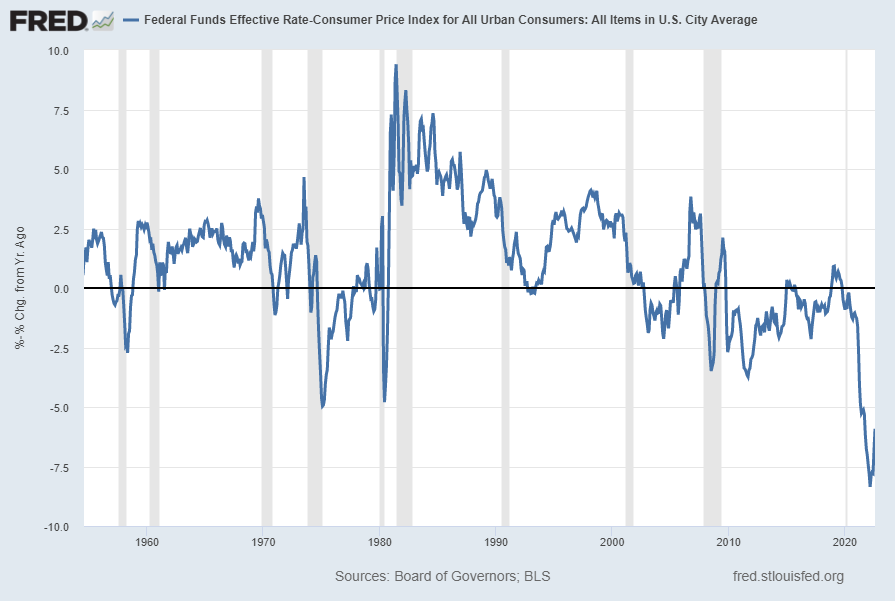
Along these lines, below is an updated long-term chart indicating the Real Fed Funds Rate [FRED FEDFUNDS – CPIAUCSL] , with a last value of -5.91923% through August 2022. [FEDFUNDS = 2.33% as of the September 1, 2022 update; CPIAUCSL = 8.2% as of the September 13, 2022 update]

Of particular note is the post-2000 persistently negative Real Fed Funds rate:

Real Fed Funds Rate -5.91923 Percent

source: Board of Governors of the Federal Reserve System (US), Effective Federal Funds Rate [FEDFUNDS], retrieved from FRED, Federal Reserve Bank of St. Louis; accessed September 16, 2022: https://fred.stlouisfed.org/series/FEDFUNDS

source: U.S. Bureau of Labor Statistics, Consumer Price Index: All Items in U.S. City Average, All Urban Consumers [CPIAUCSL], retrieved from FRED, Federal Reserve Bank of St. Louis; accessed September 16, 2022: https://fred.stlouisfed.org/series/CPIAUCSL

_____

The Special Note summarizes my overall thoughts about our economic situation

SPX at 3850.50 as this post is written

Monday, June 13, 2022

The Notable Level Of The Real Fed Funds Rate

On January 9, 2017 I wrote a post titled “Low Interest Rates And The Formation Of Asset Bubbles.“  As discussed in that post – and for other reasons – the level of the Fed Funds rate – and whether its level is appropriate – has vast importance and far-reaching consequences with regard to many aspects of the economy and financial system.

Along these lines, below is an updated long-term chart indicating the Real Fed Funds Rate [FRED FEDFUNDS – CPIAUCSL] , with a last value of -7.74641% through May 2022. [FEDFUNDS = .77% as of the June 1, 2022 update; CPIAUCSL = 8.51641% as of the June 10, 2022 update]

Of particular note is the post-2000 persistently negative Real Fed Funds rate:

Real Fed Funds Rate

source: Board of Governors of the Federal Reserve System (US), Effective Federal Funds Rate [FEDFUNDS], retrieved from FRED, Federal Reserve Bank of St. Louis; accessed June 13, 2022: https://fred.stlouisfed.org/series/FEDFUNDS

source: U.S. Bureau of Labor Statistics, Consumer Price Index: All Items in U.S. City Average, All Urban Consumers [CPIAUCSL], retrieved from FRED, Federal Reserve Bank of St. Louis; accessed June 13, 2022: https://fred.stlouisfed.org/series/CPIAUCSL

_____

The Special Note summarizes my overall thoughts about our economic situation

SPX at 3800.28 as this post is written

Wednesday, April 13, 2022

The Historic Level Of The Real Fed Funds Rate

On January 9, 2017 I wrote a post titled “Low Interest Rates And The Formation Of Asset Bubbles.“  As discussed in that post – and for other reasons – the level of the Fed Funds rate – and whether its level is appropriate – has vast importance and far-reaching consequences with regard to many aspects of the economy and financial system.

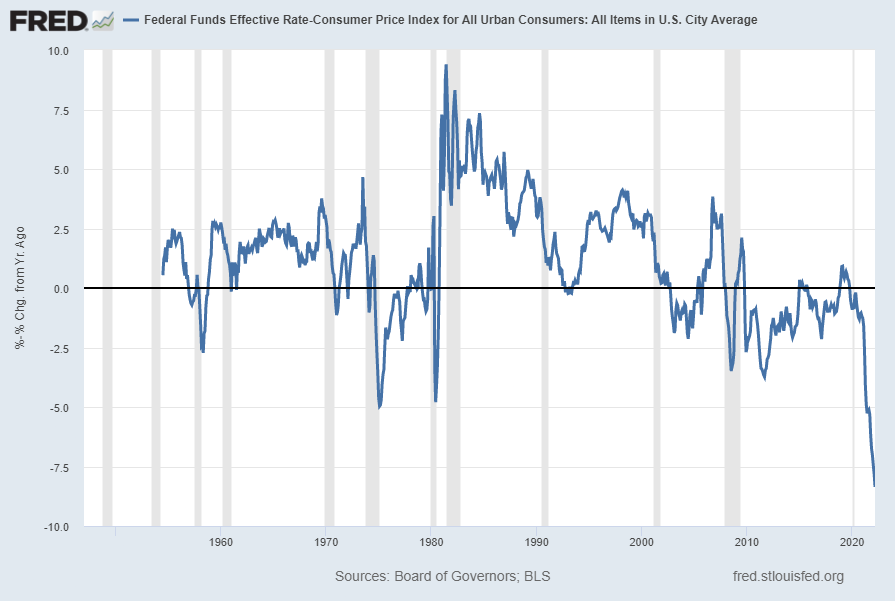
Along these lines, below is an updated long-term chart indicating the Real Fed Funds Rate [FRED FEDFUNDS – CPIAUCSL] , with a last value of -8.35759% through March 2022. [FEDFUNDS = .20% as of the April 1, 2022 update; CPIAUCSL = 8.55759% as of the April 12, 2022 update]

Of particular note is the post-2000 persistently negative Real Fed Funds rate:

Real Fed Funds Rate

source: Board of Governors of the Federal Reserve System (US), Effective Federal Funds Rate [FEDFUNDS], retrieved from FRED, Federal Reserve Bank of St. Louis; accessed April 13, 2022: https://fred.stlouisfed.org/series/FEDFUNDS

source: U.S. Bureau of Labor Statistics, Consumer Price Index: All Items in U.S. City Average, All Urban Consumers [CPIAUCSL], retrieved from FRED, Federal Reserve Bank of St. Louis; accessed April 13, 2022: https://fred.stlouisfed.org/series/CPIAUCSL

_____

The Special Note summarizes my overall thoughts about our economic situation

SPX at 4419.17 as this post is written

Wednesday, November 10, 2021

Real Fed Funds Rate Level And Its Importance

On January 9, 2017 I wrote a post titled “Low Interest Rates And The Formation Of Asset Bubbles.“  As discussed in that post – and for other reasons – the level of the Fed Funds rate – and whether its level is appropriate – has vast importance and far-reaching consequences with regard to many aspects of the economy and financial system.

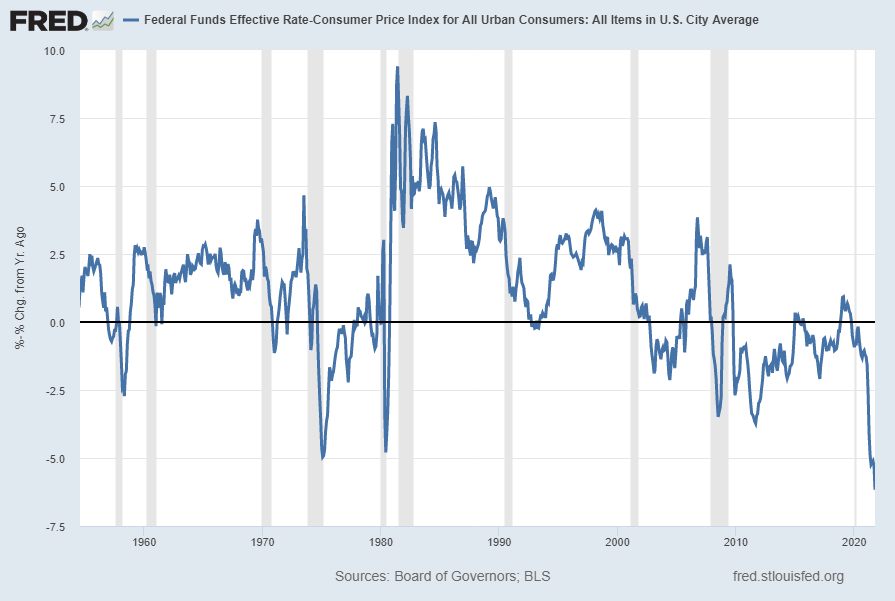
Along these lines, below is an updated long-term chart indicating the Real Fed Funds Rate [FRED FEDFUNDS – CPIAUCSL] , with a last value of -6.16352 through October 2021. Of particular note is the post-2000 persistently negative Real Fed Funds rate:

Real Fed Funds Rate chart

source: Board of Governors of the Federal Reserve System (US), Effective Federal Funds Rate [FEDFUNDS], retrieved from FRED, Federal Reserve Bank of St. Louis; accessed November 10, 2021: https://fred.stlouisfed.org/series/FEDFUNDS

source: U.S. Bureau of Labor Statistics, Consumer Price Index: All Items in U.S. City Average, All Urban Consumers [CPIAUCSL], retrieved from FRED, Federal Reserve Bank of St. Louis; accessed November 10, 2021: https://fred.stlouisfed.org/series/CPIAUCSL

_____

The Special Note summarizes my overall thoughts about our economic situation

SPX at 4676.86 as this post is written

Friday, August 20, 2021

The Real Fed Funds Rate Level And Its Importance

On January 9, 2017 I wrote a post titled “Low Interest Rates And The Formation Of Asset Bubbles.“  As discussed in that post – and for other reasons – the level of the Fed Funds rate – and whether its level is appropriate – has vast importance and far-reaching consequences with regard to many aspects of the economy and financial system.

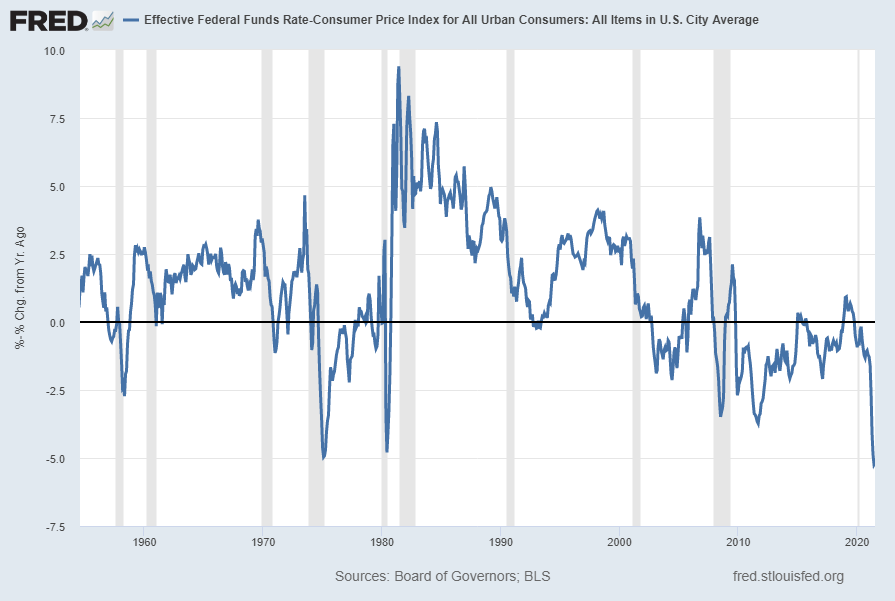
Along these lines, below is an updated long-term chart indicating the Real Fed Funds Rate [FRED FEDFUNDS – CPIAUCSL] , with a last value of -5.18259 through July 2021. Of particular note is the post-2000 persistently negative Real Fed Funds rate:

Real Fed Funds Rate -5.18259 through July 2021

source: Board of Governors of the Federal Reserve System (US), Effective Federal Funds Rate [FEDFUNDS], retrieved from FRED, Federal Reserve Bank of St. Louis; accessed August 20, 2021: https://fred.stlouisfed.org/series/FEDFUNDS

source: U.S. Bureau of Labor Statistics, Consumer Price Index: All Items in U.S. City Average, All Urban Consumers [CPIAUCSL], retrieved from FRED, Federal Reserve Bank of St. Louis; accessed August 20, 2021: https://fred.stlouisfed.org/series/CPIAUCSL

_____

The Special Note summarizes my overall thoughts about our economic situation

SPX at 4405.80 as this post is written

Tuesday, May 25, 2021

Total Assets On The Federal Reserve’s Balance Sheet As Of May 19, 2021

Federal Reserve and federal government intervention efforts remain a critical subject. I have written extensively about many types of interventions, including Quantitative Easing (QE) and past economic stimulus programs. Posts discussing these intervention measures can generally be found under the “Interventions” label.

Various aspects and dynamics of the Federal Reserve’s balance sheet are of paramount importance.

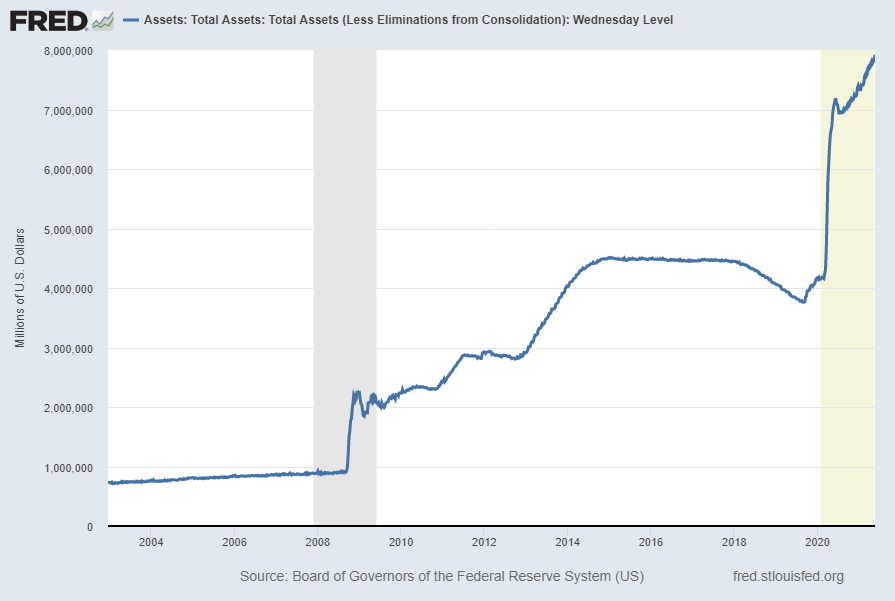
For reference purposes, below is a long-term chart of the Total Assets on the Federal Reserve’s balance sheet. The value is $7.922883 Trillion as of the May 20, 2021 update, reflecting data through May 19, 2021:

Total Assets on the Federal Reserve's Balance Sheet

source: Board of Governors of the Federal Reserve System (US), Assets: Total Assets: Total Assets (Less Eliminations from Consolidation): Wednesday Level [WALCL]; retrieved from FRED, Federal Reserve Bank of St. Louis; accessed May 25, 2021: https://fred.stlouisfed.org/series/WALCL

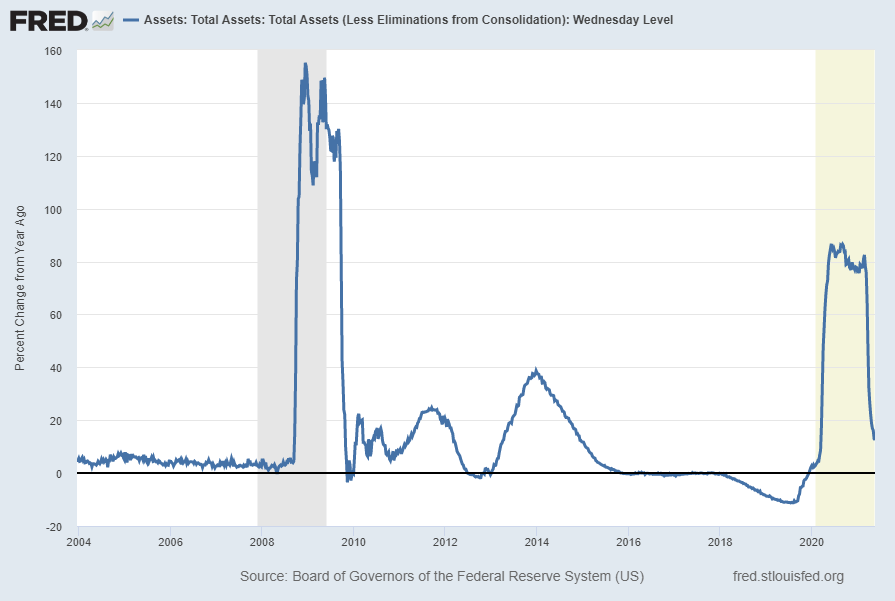
Here is this “Total Assets…” chart on a “Percent Change From Year Ago” basis, with a current value of 12.6%:

WALCL 12.6 Percent Change From Year Ago

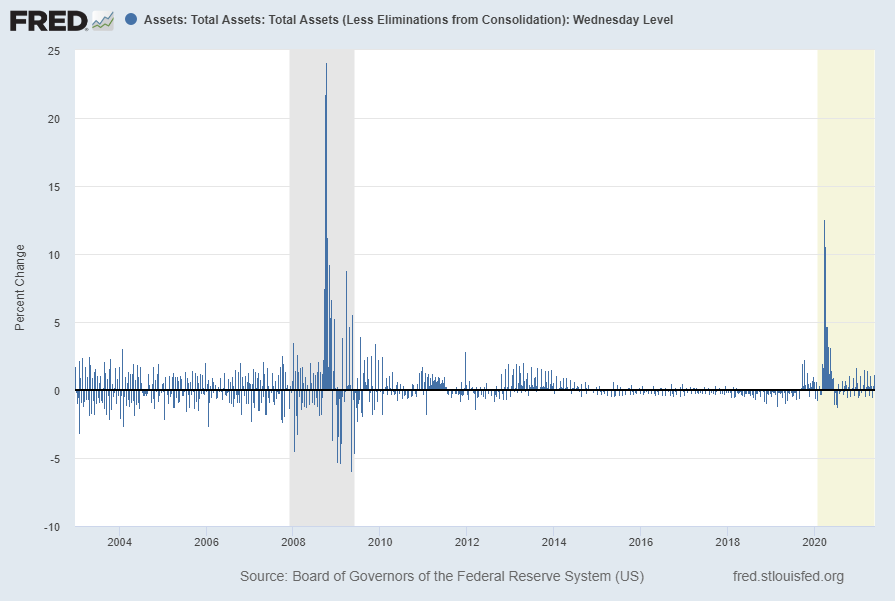
Here is this “Total Assets…” chart on a “Percent Change” basis, with a current value of 1.2%:

WALCL Percent Change

_____

The Special Note summarizes my overall thoughts about our economic situation

SPX at 4197.51 as this post is written

Monday, March 15, 2021

The American Rescue Plan – Highlights and Comments

On Thursday (March 11, 2021) President Biden signed into law “The American Rescue Plan.” This is a $1.9 Trillion stimulus package.

Comments that I found notable (although don’t necessarily agree with) from President Biden’s March 12, 2021 comments regarding the plan:

This leg- — this legislation, as everybody has already mentioned, will provide $1,400 in direct payments, which we all promised.  Well, that means for a typical family of four — a middle-class family, husband and wife working, making $110,000 a year — that means a $5,600 check they’re going to get.  Eighty-five percent of the households in America will be getting this money.  (Applause.)

also:

This legislation extends unemployment insurance by $300 a week until September.  It’s going to help 11 million Americans who were days from losing that benefit.  This legislation includes the biggest investment in childcare since World War Two.  That’s not hyperbole; that’s just a fact.  It’s a fact. 

It provides help for small businesses to stay open.  And, you know, four hundred thou- — so many have had to close because, the first time around, you all worked and did a great piece of work, and the House passed a significant legislation.  What’s the first thing the last President — he fired — he fired the folks who were supposed to watch and make sure it got, in fact, distributed the way it was supposed to.  We find out so much of it went to people who didn’t need it.  You all took care of that. 

It extends coverage and lowers healthcare costs for so many Americans.  So many Americans.  And it’s a big number for people. 

also:

And one of the things that we said in the beginning that no one thought that I was being straight about was I said: This is going to create — we — we have to spend this money to make sure we have economic growth, unrelated to how much it’s going to help people.  Well, guess what?  Every single major economist out there — left, right, and center — supported this plan.  Even Wall Street agreed.  According to Moody’s, for example, by the end of this year, this law alone will create 7 million new jobs.  (Applause.)  Seven million.

And the bill does one more thing, which I think is really important: It changes the paradigm.  For the first time in a long time, this bill puts working people in this nation first.  It’s not hyperbole; it’s a fact.  (Applause.)   

For too long, it’s been the folks at the top.  They’re not bad folks.  A significant number of them know they shouldn’t be getting the tax breaks they had.  But it put the richest Americans first, who benefited the most.  And the theory was — we’ve all heard it, and especially the last 15 years.  The theory was: Cut taxes, and those at the top and the benefits they get will trickle down to everyone.  Well, you saw what trickle down does.  We’ve known it for a long time.  But this is the first time we’ve been able to, since the Johnson administration and maybe even before that, to begin to change the paradigm. 

We’ve seen time and time again that that trickle down does not work.  And, by the way, we don’t have anything against wealthy people.  You got a great idea, you’re going to go out and make millions of dollars — that’s fine.  I have no problem with that.  But guess what?  You got to pay your fair share.  You got to pay some.  Because guess what?  Folks who are making — living on the edge, they’re paying.  And so, again, all it’s done is make those at the top richer in the past, and everyone else falling behind. 

This time, it’s time that we build an economy that grows from the bottom up and the middle out — (applause) — the middle out.  And this bill shows that when you do that, everybody does better.  The wealthy do better.  Everybody does better across the board. 

_____

For reference, this American Rescue Plan as well as the previous COVID-19 stimulus plans are discussed on the Peter G. Peterson Foundation’s March 10, 2021 page titled “Here’s Everything The Federal Government Has Done To Respond To The Coronavirus So Far.” As noted in that document, “So far, lawmakers have enacted six major bills, costing about $5.3 trillion, to help manage the pandemic and mitigate the economic burden on families and businesses.”

_____

With regard to this American Rescue Plan, I believe there is a broad array of questions that can – and should be – asked. Many of the questions are similar in nature to those that I have previously discussed with regard to the stimulus measures and other interventions taken during and after the Financial Crisis. 

_____

The Special Note summarizes my overall thoughts about our economic situation

SPX at 3943.34 as this post is written 
Wednesday, July 15, 2020

The Level Of The Real Fed Funds Rate And Its Importance

On January 9, 2017 I wrote a post titled “Low Interest Rates And The Formation Of Asset Bubbles.“  As discussed in that post – and for other reasons – the level of the Fed Funds rate – and whether its level is appropriate – has vast importance and far-reaching consequences with regard to many aspects of the economy and financial system.
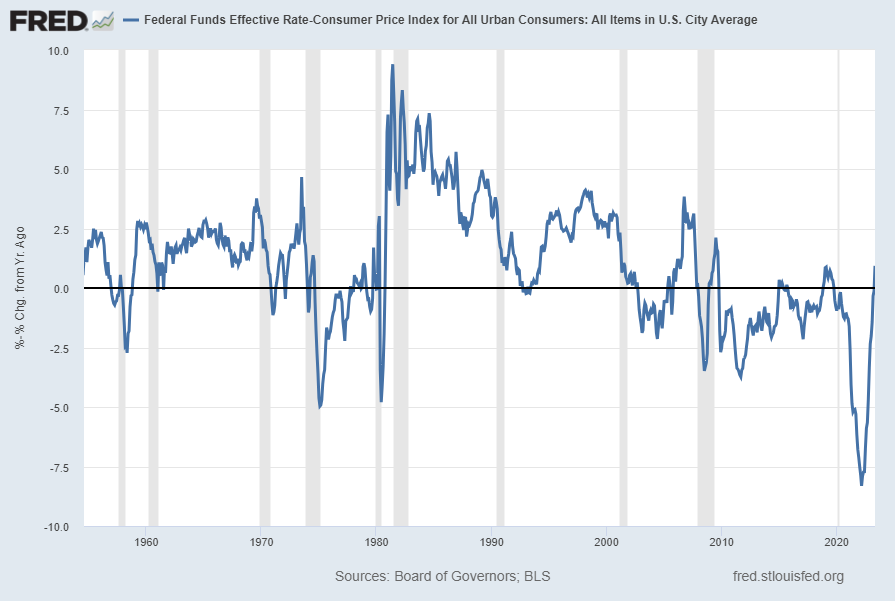
Along these lines, below is an updated long-term chart indicating the Real Fed Funds Rate [FRED FEDFUNDS – CPIAUCSL] , with a last value of -.62947 through June 2020. Of particular note is the post-2000 persistently negative Real Fed Funds rate:
Real Fed Funds rate
source: Board of Governors of the Federal Reserve System (US), Effective Federal Funds Rate [FEDFUNDS], retrieved from FRED, Federal Reserve Bank of St. Louis; accessed July 15, 2020: https://fred.stlouisfed.org/series/FEDFUNDS
source: U.S. Bureau of Labor Statistics, Consumer Price Index: All Items in U.S. City Average, All Urban Consumers [CPIAUCSL], retrieved from FRED, Federal Reserve Bank of St. Louis; accessed July 15, 2020: https://fred.stlouisfed.org/series/CPIAUCSL
_____
The Special Note summarizes my overall thoughts about our economic situation
SPX at 3227.95 as this post is written

Monday, March 30, 2020

The “CARES” Act (“Coronavirus Aid, Relief, and Economic Security Act”)

On Friday, President Trump signed into law H.R. 748, the “Coronavirus Aid, Relief, and Economic Security Act” or the “CARES” Act.
The Act authorizes over $2 Trillion to be spent. As stated in a March 27, 2020 Statement By The President:
The Act makes emergency supplemental appropriations and other changes to law to help the Nation respond to the coronavirus outbreak.
There are a broad array of questions that can – and should be – asked with regard to this stimulus bill. Many of the questions are similar in nature to those that I have discussed with regard to stimulus measures taken during and after the Financial Crisis. Of note, there is broad anticipation that additional large stimulus measures will be taken, especially if the broad-based economic weakness that is occurring – and will continue to occur – persists.
Two excerpts from President Trump’s March 27, 2020 comments regarding the “CARES” Act, as seen in the WhiteHouse.gov release titled “Remarks by President Trump at Signing of H.R.748, The CARES Act“:
THE PRESIDENT:  Well, thank you all very much.  This is a very important day.  I’ll sign the single-biggest economic relief package in American history and, I must say, or any other package, by the way.  It’s twice as large as any relief ever signed.  It’s $2.2 billion, but it actually goes up to 6.2 — potentially — billion dollars — trillion dollars.  So you’re talking about 6.2 trillion-dollar bill.  Nothing like that.  And this will deliver urgently needed relief to our nation’s families, workers, and businesses.  And that’s what this is all about.
also:
This legislation provides for direct payments to individuals and unprecedented support to small businesses.  We’re going to keep our small businesses strong and our big businesses strong.  And that’s keeping our country strong and our jobs strong.
This historic bill includes the following:
  • $300 billion in direct cash payments will be available to every American citizen earning less than $99,000 per year; $3,400 for a typical family of four.  So a family of four: $3,400.
  • And then $350 billion in job retention loans for small businesses, with loan forgiveness available for businesses that continue paying their workers.  The workers get paid.
  • Approximately $250 billion in expanded unemployment benefits.  The average worker who has lost his or her job will receive 100 percent of their salary for up to four full months.
So, things like this have never happened in our country.
  • $500 billion in support for hard-hit industries, with a ban on corporate stock buybacks — we don’t let them buy back the stock; we don’t let that happen — and tough limits on executive compensation.
  • Over $100 billion to support our heroic doctors, nurses, and hospitals.  And you see what’s happening.  And I want to thank, while we’re here, also the incredible job that’s done by the Army Corps of Engineers and by FEMA.  It’s been incredible.  They did four hospitals in two days or three days, in New York.  And they’re, like, incredible structures.  What a job they’ve been doing.  And they’re doing them all over the country.
  • $45 billion for the Disaster Relief Fund, supporting our state, local, and tribal leaders.
  • $27 billion for the development of vaccines, therapies, and other public health response efforts, including $16 billion to build up the Strategic National Stockpile with critical stockpiles.  And I’m going to — we have tremendous supplies coming into the stockpile, and you’ll be seeing that and hearing about it in a little bit because we’re doing a news conference at 5:30 on what’s happening.
_____
Additional details regarding the allocations of this “CARES” Act can be seen in a variety of media sources, including the Committee for a Responsible Federal Budget (CRFB) March 25, 2020 post titled “What’s in the $2 Trillion Coronavirus Relief Package?
_____
The Special Note summarizes my overall thoughts about our economic situation
SPX at 2584.97 as this post is written 

Monday, March 23, 2020

Additional Notable Federal Reserve Actions To Address Weakness

On Friday (March 20, 2020) I wrote a post (“Federal Reserve Actions To Address Financial And Economic Weakness“) detailing recently announced Federal Reserve actions intended to address various problematical conditions. These conditions include actual and expected substantial economic weakness, financial instability, and various rapidly falling asset prices.
In that post I also highlighted my thoughts on intervention efforts. I have written extensively about interventions of all types, including Quantitative Easing (QE) and past economic stimulus programs. Posts discussing intervention measures can generally be found in the “Interventions” label.
Early today (March 23, 2020) the Federal Reserve made additional announcements. Among those announcements was one regarding the amount of QE it will possibly do, as well as other newly enacted intervention programs.
The new announcement with regard to QE is discussed in this March 23 FOMC Statement. An excerpt:
The Federal Open Market Committee is taking further actions to support the flow of credit to households and businesses by addressing strains in the markets for Treasury securities and agency mortgage-backed securities. The Federal Reserve will continue to purchase Treasury securities and agency mortgage-backed securities in the amounts needed to support smooth market functioning and effective transmission of monetary policy to broader financial conditions. The Committee will include purchases of agency commercial mortgage-backed securities in its agency mortgage-backed security purchases. In addition, the Open Market Desk will continue to offer large-scale overnight and term repurchase agreement operations. The Committee will continue to closely monitor market conditions, and will assess the appropriate pace of its securities purchases at future meetings.
The paramount phrase is that the stated asset purchases will be done “in the amounts needed.” Most observers appear to interpret this as (potentially) “unlimited QE.”
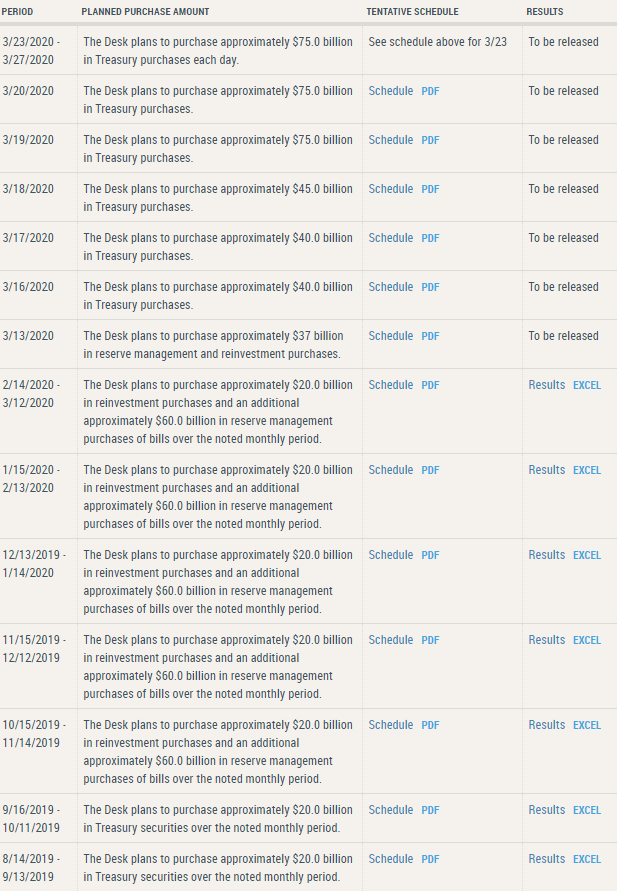
For reference, a schedule of past and planned Treasury purchases can be seen in the table below, from the Federal Reserve Bank of New York’s “Treasury Securities Operational Details” page:

Treasury Securities Operational Details as seen on March 23, 2020

Also, the planned MBS purchases, of $50B each day this week, are discussed in the March 23, 2020 “Statement Regarding Treasury Securities and Agency Mortgage-Backed Securities Operations” release.

As well, a separate announcement, titled “Federal Reserve announces extensive new measures to support the economy” lists other newly-announced programs. An excerpt (further explanation and details are seen in the press release):
  • Supporting the flow of credit to employers, consumers, and businesses by establishing new programs that, taken together, will provide up to $300 billion in new financing. The Department of the Treasury, using the Exchange Stabilization Fund (ESF), will provide $30 billion in equity to these facilities.
  • Establishment of two facilities to support credit to large employers – the Primary Market Corporate Credit Facility (PMCCF) for new bond and loan issuance and the Secondary Market Corporate Credit Facility (SMCCF) to provide liquidity for outstanding corporate bonds.
  • Establishment of a third facility, the Term Asset-Backed Securities Loan Facility (TALF), to support the flow of credit to consumers and businesses. The TALF will enable the issuance of asset-backed securities (ABS) backed by student loans, auto loans, credit card loans, loans guaranteed by the Small Business Administration (SBA), and certain other assets.
  • Facilitating the flow of credit to municipalities by expanding the Money Market Mutual Fund Liquidity Facility (MMLF) to include a wider range of securities, including municipal variable rate demand notes (VRDNs) and bank certificates of deposit.
  • Facilitating the flow of credit to municipalities by expanding the Commercial Paper Funding Facility (CPFF) to include high-quality, tax-exempt commercial paper as eligible securities. In addition, the pricing of the facility has been reduced.
_____
_____
The Special Note summarizes my overall thoughts about our economic situation
SPX at 2270.23 as this post is written

Friday, March 20, 2020

Federal Reserve Actions To Address Financial And Economic Weakness

Recently, the Federal Reserve has taken many substantial actions to address financial market weakness, as well as an actual and expected very large drop in economic activity.
In addition to the actions taken by the Federal Reserve, there are various actions taken at the Federal, State, and local levels. These programs are largely still being formulated.
Some of the stimulus programs being formulated at the Federal level are very large, likely in the trillions of dollars.
The following is a list of action, programs, and interventions recently taken by the Federal Reserve. Of note, many of these programs were enacted or otherwise used during the Financial Crisis. The below list does not necessarily include all of the actions taken to date:
-The Federal Reserve, in two steps (March 3 & March 15), decided to lower the target range for the federal funds rate to 0 to 1/4 percent; this second rate cut is discussed in the FOMC Press Conference discussed in the “March 15, 2020 FOMC Press Conference” post. As well, as discussed in that FOMC Press Conference, additional asset purchases, i.e. Quantitative Easing (QE).
Many other programs and interventions, as detailed on the Federal Reserve’s “Coronavirus Disease 2019 (COVID-19)” page. Among these programs are:
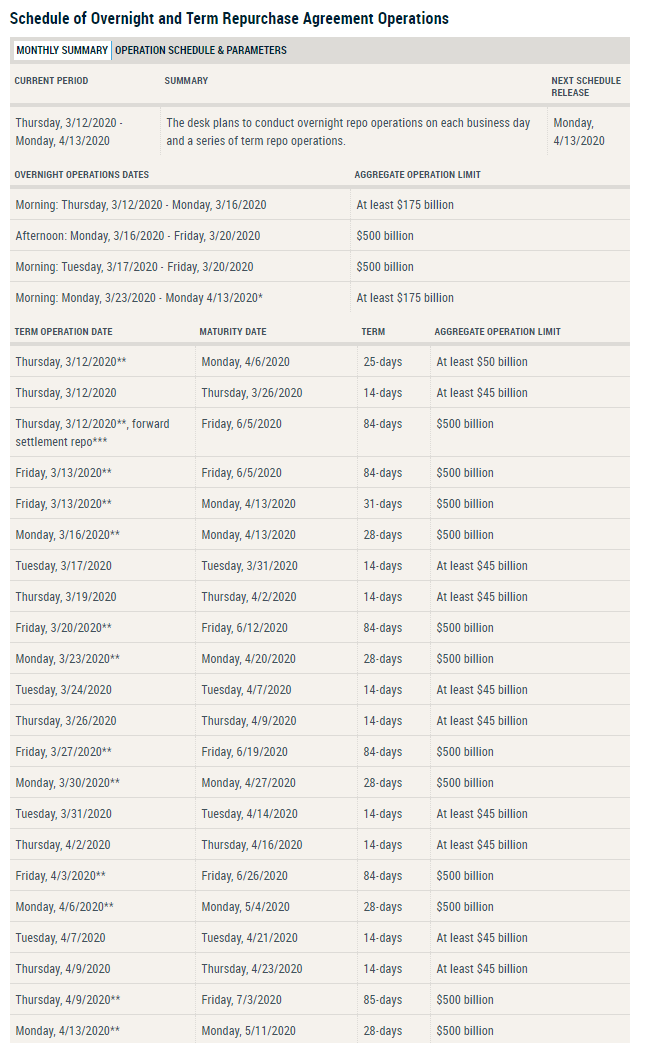
As well, there has been a very substantial, continuing increase in the Federal Reserve Repurchase Agreements (e.g. “repos”.) A list of the scheduled New York Federal Reserve’s Repo operations, as of the latest (March 16, 2020) update:
New York Federal Reserve Schedule of Overnight and Term Repurchase Agreement Operations
I have written extensively about interventions of all types, including Quantitative Easing (QE) and past stimulus programs. Posts discussing intervention measures can generally be found in the “Interventions” label.
As I have previously written, my analyses indicate that, in general, while interventions are intended to provide beneficial effects to the markets and economy, they also present an array of risks, detrimental impacts, and unintended consequences. They have many complex impacts on the economy and financial markets. 
_____
The Special Note summarizes my overall thoughts about our economic situation
SPX at 2427.88 as this post is written