Wednesday, May 26, 2010

Updates On Economic Indicators

Here is an update on various indicators that are supposed to predict and/or depict economic activity.  These indicators have been discussed in previous blog posts:

The May Chicago Fed National Activity Index (CFNAI) (pdf) updated as of May 24, 2010:


The Consumer Metrics Institute Contraction Watch:


The USA TODAY/IHS Global Insight Economic Outlook Index:

An excerpt of May 24, 2010:
"The May update of the USA TODAY/IHS Global Insight Economic Outlook Index shows strong growth in real GDP, at a six-month annualized growth rate, in April and May followed by slower, yet solid, growth in June through October. Increased consumer and business spending will fuel strong growth into the second quarter, but tight credit, high debt and still-high unemployment will moderate growth in the second half of the year."

The ECRI WLI (Weekly Leading Index) : Last updated 5/14/10:
The WLI is at 127.3

The Dow Jones ESI (Economic Sentiment Indicator):
The Index as of April 30 was at 38.3.  The title of the April 30 news release is "Dow Jones Economic Sentiment Indicator slips to 38.3 for April; signals that Recovery has yet to firmly take hold."

The Aruoba-Diebold-Scotti Business Conditions (ADS) Index
Here is the latest chart, updated through 5-15-10:


“New Financial Conditions Index”
I had a post of this index on 3/10/10.  There is currently no updated value available.
_________
I post various indicators and indices because I believe they should be carefully monitored.  However, as those familiar with this blog are aware, I do not necessarily agree with what they depict or imply.

back to home

SPX at 1074.14 as this post is written

Monday, May 24, 2010

MacroMarkets Home Price Expectations Survey

On May 19 The Wall Street Journal had an article about a new housing survey called the MacroMarkets Home Price Expectations Survey.

From the MacroMarkets.com website:

"MacroMarkets has assembled a distinguished panel of over 100 economists, investment strategists, and housing market analysts who are surveyed every month regarding their 5-year expectations for future home prices in the United States."

The Wall Street Journal article summarized the May 2010 survey results as follows:

"The analysts surveyed by MacroMarkets on average expect home prices, as measured by the S&P/Case-Shiller national index, to rise about 12% in the five years ending Dec. 31, 2014. As of Dec. 31, that index was down about 28% from its peak level in mid-2006."

However, if one looks at the detail (pdf), one sees a significant differing of opinions, with the highest cumulative gain (through 2014) expected to be 36.74% and the lowest a loss of 17.99%.

This survey should be interesting to watch as it provides a relatively broad view of housing price expectations on a recurring basis.

As for the survey results - I find them interesting.  The overall consensus view on housing seems to mirror this survey's average forecasted results - that of mild but steady home price appreciation over the next few years.
_____

I've written extensively about housing, as it is of the utmost importance to our economic situation.  Our national real estate problems are vastly complex and highly problematical.  Perhaps my overall view on the situation and the path of housing prices is best summarized by my January 8, 2010 post.

back to home

SPX at 1087.69 as this post is written

Friday, May 21, 2010

Four Erroneous Phrases

Over the last few months, four phrases have been used frequently in describing our economic condition.  I find these phrases to be inaccurate and misleading.

Here are the four phrases (in italics) and some brief commentary:

"the Great Recession"

Many people have labeled the economic weakness (ended by the subsequent purported economic recovery) as "the Great Recession."  This appears to be in recognition of a deep recession that in many ways seemed to be second only to The Great Depression as far as severity.

I believe the phrase to be inaccurate as my analysis indicates we have yet to experience the full extent of the economic weakness -  and as such categorizing weakness to date is premature.  Also, I find the term "Great Recession" to be rather glib and flippant, as it minimizes the extent of our economic difficulties.

"employment is a lagging indicator"

This phrase is heard constantly.  It seems as if the more it is said, the more accepted it becomes.  I believe that although employment may have been a "lagging indicator" in the past, during our current period of economic weakness it is either a coincident or leading indicator, depending upon the time horizon and other guidelines used.

"saddling our children / grandchildren with debt"

This phrase, and variants, is often heard in relation to the expansion of deficits and national debt.  While I don't believe it is wholly inaccurate, I think it embodies various mistaken beliefs.  Among these mistaken beliefs are that we as a country will not face near-term repercussions from our amassing of debts; and that the worst consequence (and only one worthy of mention) of our current economic actions with regard to future generations' prosperity is our amassing of debt.

The broader, and more important question -  which is seemingly never mentioned - is whether we are acting as "good stewards" in relation to the economic condition that will be faced by future generations.  In essence, is the current generation promoting an economic environment that will bode well for future generations?  I will likely discuss this topic in the future.

the "Flash Crash"

This phrase has been frequently used to describe the sudden, deep decline of the stock market on May 6.  I don't think the phrase is accurate for a number of reasons.  Again, the phrase sounds glib and implies that the decline lacked (lasting) significance or happened without significant reason or provocation.
_____

There are many other erroneous phrases used frequently to discuss our economic condition.  In the future I will highlight others that I believe have outsized significance.

back to home

SPX at 1074.33 as this post is written

Thursday, May 20, 2010

The "Paycheck To Paycheck" Condition

Yesterday The Wall Street Journal had a story about Wal-Mart's results.

I found two aspects of the story notable.  First, the sales results seemed particularly low in relation to the recent widespread media coverage of strong retail sales.  Wal-Mart "said that U.S. sales at stores open at least a year fell 1.1%, and store visits dropped despite recent attempts to attract shoppers with price cuts."

Second, a comment in the story caught my attention.  CFO Tom Schoewe is quoted saying, "More than ever, our customers are living paycheck to paycheck."

I've commented on this "paycheck to paycheck" issue previously.  It is a very unfortunate situation and one that is a testament to the widespread lack of prosperity.  While accurate statistics of the "paycheck to paycheck" situation are hard to find, it seems as if it is a widespread condition among many income levels.

back to home

SPX at 1115.05 as this post is written

Wednesday, May 19, 2010

Stock Market Volatility

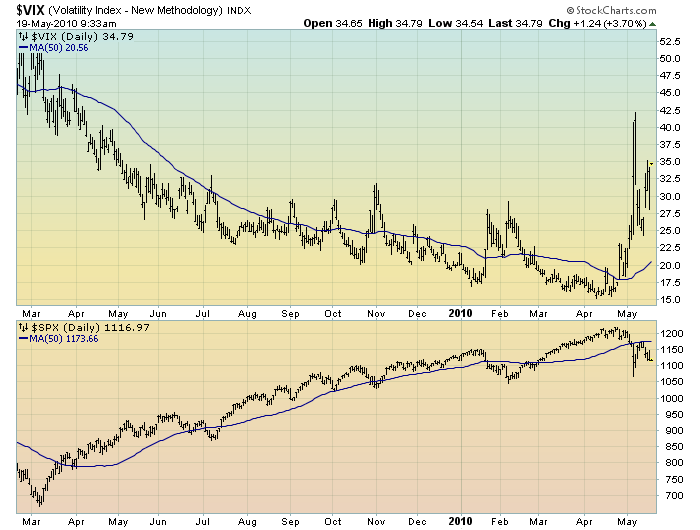
As seen in the chart below, the 50 day moving average (as seen in blue) for the VIX is now trending higher.  This is the first time since March 2009 in which it has done so in a significant manner:


chart courtesy of StockCharts.com

Of course, there are many different ways to measure volatility.  Other measures are showing a significant increase as well.

I expect there to be significant, and steadily increasing (relative to the past 15 months) volatility going forward.  This will be seen in both up and down price movements.

This volatility is being caused by a variety of factors.

I believe that we are building to a variety of major market events.  I will be elaborating upon this shortly.

back to home

SPX at 1116.65 as this post is written

Monday, May 17, 2010

The May 2010 Wall Street Journal Economic Forecast Survey

The May Wall Street Journal Economic Forecast Survey focuses on the economic problems in Europe and the odds of The Federal Reserve increasing interest rates.

As seen in the detail of this survey, the current average forecasts for December 31, 2010 among economists polled include the following:

Ten-Year Treasury Yield: 4.16%
CPI: 1.8%
Unemployment: 9.3%
Crude: $81.56
GDP (full year 2010) : 3.2%
GDP (full year 2011) : 3.1%

Of note, with the exception of the Crude forecast, the above categories have not seen much change in average expectations for up to a year.
_____

I post various economic forecasts because I believe they should be carefully monitored.  However, as those familiar with this blog are aware, I do not agree with the many of the consensus estimates and much of the commentary in these forecast surveys.

back to <home>

SPX at 1135.68 as this post is written

Sunday, May 16, 2010

Milton Friedman On Monetary And Fiscal Policy

I found this passage from Milton Friedman in 1958, as seen on John B. Taylor's blog, to be notable, especially given the immense monetary and fiscal policy actions taken to "improve" our economic situation:

"The available evidence…casts grave doubt on the possibility of producing any fine adjustments in economic activity by fine adjustments in monetary policy....and much danger that such a policy may make matters worse rather than better…The basic difficulties and limitations of monetary policy apply with equal force to fiscal policy.

Political pressures to ‘do something’ …are clearly very strong indeed in the existing state of public attitudes.

The main moral to be had from these two preceding points is that yielding to these pressures may frequently do more harm than good. There is a saying that the best is often the enemy of the good, which seems highly relevant. The attempt to do more than we can will itself be a disturbance that may increase rather than reduce instability."
_____

back to home

SPX at 1135.68 as this post is written

Friday, May 14, 2010

"Is America In Decline?"

I found this exchange on last Sunday's (May 9) "60 Minutes" to be interesting.  It is between Scott Pelley of "60 Minutes" and Hillary Clinton.  For now I will simply post the exchange, and may comment upon it later:

Pelley:  "Larry Summers, the president's economic advisor, asked this question: 'How long can the world's biggest borrower remain the world's greatest power?' Is America in decline?"

Clinton:  "No. We're not. But it's a question that has to be answered."


SPX at 1157.44 as this post is written