Wednesday, September 19, 2012

Notable FedEx Comments Of September 18, 2012


Yesterday, FedEx conducted their Q1 2013 Earnings Conference call.  A New York Times article dated September 18, titled "FedEx Lowers Forecast, Citing Weak Economy" summarizes various aspects of FedEx's results and outlook.

While I found several comments and forecasts to be interesting, I found a couple of statements by Frederick W. Smith regarding global trade, seen in the FedEx Earnings Conference call transcript, to be particularly noteworthy.

Here is the first:
Frederick W. Smith - Founder, Executive Chairman, Chief Executive Officer and President
This is Fred Smith. Let me weigh in here, Tom. I mean, fundamentally, what's happening is that exports around the world have contracted, and the policy choices in Europe and the United States and China are having an effect on global trade. Global trade has grown faster than GDP, except for the 2000, 2001 meltdown and 2008 and 2009, for 25 years. And over the last few months, that has not been the case. So that's what's really going on, is that exports and trade have gone down at a faster rate than GDP has.
Here is the second:
Frederick W. Smith - Founder, Executive Chairman, Chief Executive Officer and President
I can tell you this on China. The locomotive that has driven China's growth is its export industries. And with the situation in Europe and, to a lesser degree, in North America, that is a significant issue for the Chinese economy. Now the consumer consumption in China is not increasing at a significant rate, contrary to everybody's hopes. While exports from, say, the United States into China have grown, they are dwarfed by the exports from China into the United States. And as the big economies in Europe and the U.S. have grown or contracted -- grown at a far lesser rate or, in the case of certain European countries, have contracted, that's reflected in the numbers in China. And you can't escape that. I've been somewhat amused watching some of the China observers, I think, completely underestimate the effects of the slower exports on the overall China economy.
-

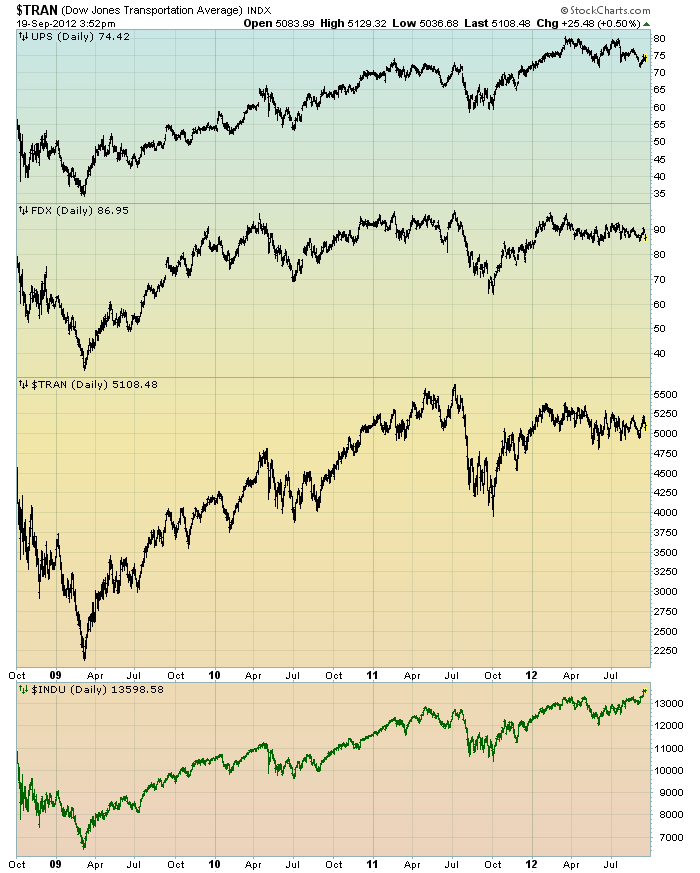
For reference, here is a chart, on a daily basis from October 2008, displaying stock prices of UPS, FedEx, the Dow Jones Transportation Index, and the Dow Jones Industrials:

(click on chart to enlarge image)(chart courtesy of StockCharts.com; chart creation and annotation by the author)

_____

The Special Note summarizes my overall thoughts about our economic situation

SPX at 1461.43 as this post is written

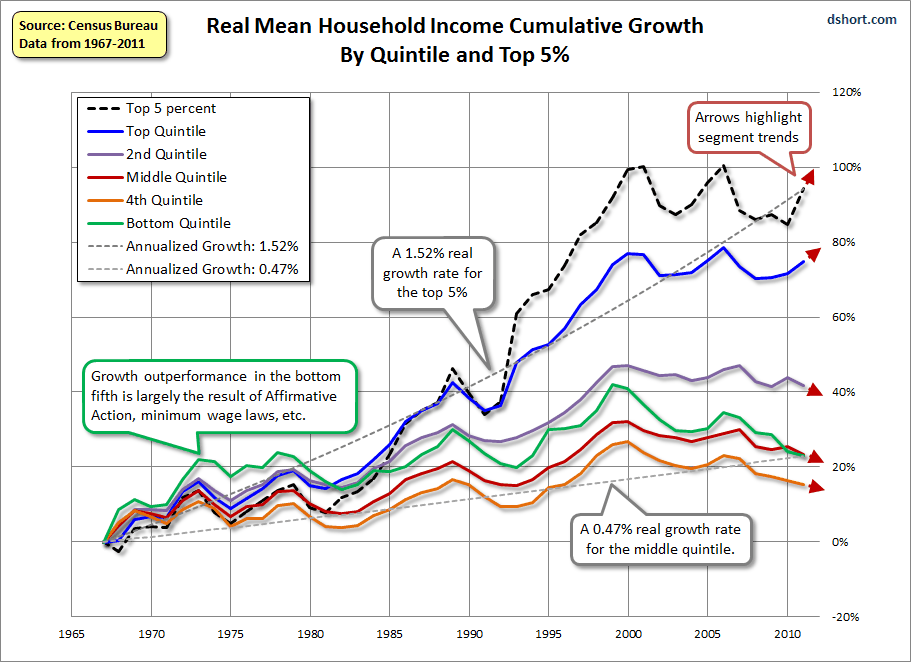
U.S. Real Mean Household Income Growth Chart 1967-2011


In the September 20, 2010 post I first highlighted the lack of significant long-term growth in Real Median Income.

Doug Short, in his September 18 blog post titled “U.S. Household Incomes:  A 44-Year Perspective,” has a variety of charts and commentary on various facets of Household Income distributions and growth.

One chart, seen below, seems particularly interesting.  It is a depiction of Real Mean Household Income Cumulative Growth By Quintile and Top 5%, from 1967 to 2011:

(click on chart to enlarge image)


-

In a different post on September 18, Doug also had another notable post concerning household incomes, this one categorized by age brackets.  That post is titled "U.S. Median Households Incomes by Age Bracket:  2011 Was a Bleak Year."
_____

The Special Note summarizes my overall thoughts about our economic situation

SPX at 1465 as this post is written

Tuesday, September 18, 2012

QE3 Comments


In this post I will make a few (belated) comments regarding QE3, as announced by Ben Bernanke on Thursday. I highlighted notable aspects of that Press Conference, as well as provided links to the transcript, economic projections and FOMC Statement in the September 15 post ("Ben Bernanke's September 13, 2012 Press Conference - Notable Aspects.")

While I could make many comments about Thursday's announcement, I will at this point briefly comment on a few aspects.  I have previously written extensively about the characteristics and risks of Quantitative Easing and Interventions as I believe many aspects of these practices lack recognition and understanding.

With regard to Thursday's Press Conference, one aspect I found disconcerting was the discussion of QE3's risks.  First, I found it disconcerting that "risks" was not a term used, but rather "costs" (e.g. from the transcript "Of course, in determining the size, pace, and composition of any additional asset purchases, we will, as always, take appropriate account of the inflation outlook and of their efficacy and costs.")  While some may view this as semantics, I believe that the term "risks" is far more descriptive and appropriate.

Another notable aspect of the Press Conference was Ben Bernanke's address of "three concerns" regarding additional quantitative easing.  As seen on the transcript:
Before I take your questions, I’d like to briefly address three concerns that have been raised about the Federal Reserve’s accommodative monetary policy. The first is the notion that the Federal Reserve’s securities purchases are akin to fiscal spending. The second is that a policy of very low rates hurts savers. The third is that the Federal Reserve’s policies risk inflation down the road.
As I have written extensively, quantitative easing in general carries an array of risks, detrimental impacts, unintended consequences, and complex impacts on the economy and markets.  The three "concerns" mentioned above, while significant, in my opinion are just a small fraction of areas of concern.

One area of tremendous concern is that of the (eventual) exit from the Quantitative Easing measures.  One of my main concerns with regard to the exit is if it is done under "exigent circumstances" as opposed to under "normal" conditions.  While an exit under normal conditions may - or may not be - orderly and nondisruptive to the economy and markets, an exit under "exigent circumstances" will likely be very traumatic.  I first mentioned this "exigent circumstances" issue in the December 17, 2010 post ("Quantitative Easing Exit Issues") and it remains a very significant concern.

Another aspect of concern is the impact QE3 will have.  This issue is very complex.  While I don't necessarily agree with his view on the matter, I found Ben Bernanke's comments - one seen below - to be very significant:
We do think that these policies can bring interest rates down. Not just treasury rates but a whole range of rates, including mortgage rates and rates for corporate bonds and other types of important interest rates. It also affects stock prices. It affects other asset prices, home prices for example. So looking at all the different channels of effect, we think it does have impact on the economy, it will have impact on the labor market but as again, the way I would describe it is a meaningful effect, a significant effect but not a panacea, not a solution for the whole issue. We're just trying to get the economy to move in the right direction to make sure that we don't stagnate at high levels of unemployment, that we're making progress towards more acceptable levels of unemployment.
Quantitative Easing remains an important and contentious practice, and I intend to further comment on it as conditions warrant.
_____

The Special Note summarizes my overall thoughts about our economic situation

SPX at 1458.59 as this post is written

Monday, September 17, 2012

September 2012 Duke/CFO Magazine Global Business Outlook Survey – Notable Excerpts


On September 11 the September Duke/CFO Magazine Global Business Outlook Survey (pdf) was released.  It contains a variety of statistics regarding how CFOs view business and economic conditions.

In this CFO Survey, I found the following to be notable excerpts:
U.S. CFOs are growing more pessimistic about the American economy, with hiring and spending plans significantly weakening since last quarter. Finance chiefs say that their business spending plans are not sensitive to moderate changes in interest rates, suggesting that there is little that the Federal Reserve can do to stimulate investment at this time. In addition, CFO concerns about Europe also have increased in the past three months.
also:
The Federal Reserve’s attempts to reduce interest rates will have little impact on corporate investment, say CFOs. Ninety-one percent of firms say their spending plans would not change if interest rates were to fall by 1 percentage point. Eighty-four percent say a 2 percent rate reduction would not affect their spending plans.
also:
Harvey called it “amazing that all the focus is on interest rates when they are already at 50-year lows. We also asked about the impact of increased borrowing costs. Nearly 94 percent of CFOs would make no change in their investment plans if borrowing rates jumped up by 1 percent.
also:
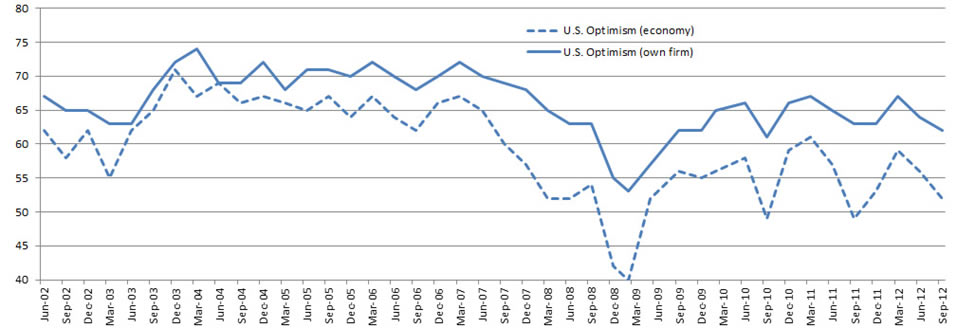
Forty-four percent of U.S. CFOs say that have become more pessimistic about the economy, twice as many as the 22 percent that say they have become more optimistic. The Optimism Index decreased to 52 (on a scale from 0 to 100), down from 56 last quarter and 59 in the spring.
also:
U.S. businesses list a number of concerns that have reduced their optimism, including the ability to maintain profit margins, the cost of health care, difficulty in attracting and retaining qualified employees, and maintaining employee morale. The list of external concerns is topped by weak demand for products, federal government policies, intense price pressure and competition, and global economic instability.
also:
Corporate plans for earnings, spending and hiring all softened this quarter. Earnings for public U.S. firms are expected to increase 6 percent over the next year.
also:
Hiring is expected to increase by 1.5 percent in the next year, down from greater than 2 percent growth reported in the last two surveys.
The CFO survey contains the Optimism Index chart, showing U.S. Optimism (with regard to the economy) at 52, as seen below:


-

It should be interesting to see how well the CFOs predict business and economic conditions going forward.   I discussed various aspects of this, and the importance of these predictions, in the July 9 2010 post titled “The Business Environment”.

(past posts on CEO and CFO Surveys can be found under the “CFO and CEO Confidence” label)
_____

I post various economic forecasts because I believe they should be carefully monitored.  However, as those familiar with this blog are aware, I do not necessarily agree with many of the consensus estimates and much of the commentary in these forecast surveys.
_____

The Special Note summarizes my overall thoughts about our economic situation

SPX at 1463.37 as this post is written

Saturday, September 15, 2012

Ben Bernanke’s September 13, 2012 Press Conference – Notable Aspects


On Thursday, September 13, 2012 Ben Bernanke gave his scheduled press conference.

Below are Ben Bernanke’s comments I found most notable – although I don’t necessarily agree with them – in the order they appear in the transcript.  These comments are excerpted from the "Transcript of Chairman Bernanke’s Press Conference"(preliminary)(pdf) of September 13, 2012, with accompanying "FOMC Statement" and "Economic Projections of Federal Reserve Board Members and Federal Reserve Bank Presidents, September 2012" (pdf).

From Ben Bernanke's opening comments:

As you know, the Federal Reserve conducts monetary policy under a dual mandate from Congress to promote maximum employment and price stability. The United States has enjoyed broad price stability since the mid-1990s and continues to do so today. The employment situation, however, remains a grave concern.

also:

The weak job market should concern every American. High unemployment imposes hardship on millions of people, and it entails a tremendous waste of human skills and talents.  Five million Americans have been unemployed for more than six months, and millions more have left the labor force--many of them doubtless because they have given up on finding suitable work. As the skills of the long-term unemployed atrophy and as their connections to the labor market wither, they may find it increasingly difficult to get good jobs, to their and their families’ cost, of course, but also to the detriment of our nation’s productive potential.

also:

Accordingly, the FOMC decided today on new actions, electing to expand its purchase of securities and extend its forward guidance regarding the federal funds rate. Specifically, the Committee decided to purchase additional agency mortgage–backed securities (MBS) at a pace of $40 billion per month. The new MBS purchases--combined with the existing maturity extension program and the continued reinvestment of principal payments from agency debt and agency MBS already on our balance sheet--will result in an increase in our holdings of longerterm securities of about $85 billion each month for the remainder of the year. The program of MBS purchases should increase the downward pressure on long-term interest rates more generally, but also on mortgage rates specifically, which should provide further support to the housing sector by encouraging home purchases and refinancing.

The Committee also took two steps to underscore its commitment to ongoing support for the recovery. First, the Committee will closely monitor incoming information on economic and financial developments in coming months, and if we do not see substantial improvement in the outlook for the labor market, we will continue the MBS purchase program, undertake additional asset purchases, and employ our policy tools as appropriate until we do. We will be looking for the sort of broad-based growth in jobs and economic activity that generally signal sustained improvement in labor market conditions and declining unemployment. Of course, in determining the size, pace, and composition of any additional asset purchases, we will, as always, take appropriate account of the inflation outlook and of their efficacy and costs.

Bernanke’s responses as indicated to the various questions:

ZACHARY GOLDFARB: Thank you Mr. Chairman. Earlier this year, two occasions, the Fed took policy actions which you defended as extremely important for the economy but as you mentioned, there hasn't been any improvement in the labor markets since the beginning of the year. Why should people believe this will make a difference? And, the projections seem to suggest it's approximately a 0.4 reduction on unemployment. Is that the limit of what Fed policies can do going forward?
CHAIRMAN BERNANKE: Well our assessment, I talked about this at my remarks at Jackson Hole. Our assessment and that of the research literature is that the polices we've undertaken have had real benefits for the economy, that they have provided some support, that they have eased financial conditions, and help reduce unemployment. All that being said, monetary policy, as I've said many times, is not a panacea. It's not by itself able to solve these problems. We're looking for policy makers in other areas to do their part. We'll do our part and we'll try to make sure that unemployment moves in the right direction but we can't solve this problem by ourselves.

also:

MIKE MCKEE: You've made an eloquent explanation over the past couple of weeks of the Fed's ability to lower interest rates. But what's missing for many economists is how the transmission mechanism is going to work. Most people think this will have a minimal effect on rates. Can you give us an idea of how much you think it might push rates down? And why moving rates down a few basis points might change demand which seems to be the problem in the economy?
CHAIRMAN BERNANKE: Well, the ultimate effect is going to depend of course on how much we end up doing and that in turns is going to be depend what the economy does. And this is a conditional program. We're going to providing accommodation according to how the economy evolves. I think that's the virtue of putting it this ways is that if the economy is weaker, we'll provide more support. If the economy strengthens on its own or other head wins die down then it will require less supports. So the amount of support we provide is going to depend on how the economy evolves. We do think that these policies can bring interest rates down. Not just treasury rates but a whole range of rates, including mortgage rates and rates for corporate bonds and other types of important interest rates. It also affects stock prices. It affects other asset prices, home prices for example. So looking at all the different channels of effect, we think it does have impact on the economy, it will have impact on the labor market but as again, the way I would describe it is a meaningful effect, a significant effect but not a panacea, not a solution for the whole issue. We're just trying to get the economy to move in the right direction to make sure that we don't stagnate at high levels of unemployment, that we're making progress towards more acceptable levels of unemployment.

also:

PEDRO DA COSTA: Pedro da Costa from Reuters. My question is I want to go back to the transmission mechanism because speaking to people on the sidelines of Jackson Hole conference that seemed to be the concern about the remarks that you made is that they could clearly see the effect on rates and they could see the effect on the stock market but they couldn't see how that had helped the economy. So I think there's a fear that over time, this has been a policy that's helping Wall Street but not doing that much for Main Street. So could you describe in some detail how does it really different--differ from trickle-down economics where you just pumped money into the banks and hope that they lend?
CHAIRMAN BERNANKE: Well we are--this is a Main Street policy because what we are about here is trying to get jobs going. We are trying to create more employment. We are trying to meet our maximum employment mandate, so that is the objective. Our tools involve, I mean the tools we have, involve affecting financial asset prices and that's--those are the tools of monetary policy. There are a number of different channels, mortgage rates, I mentioned, other interest rates, corporate bond rates, but also the prices of various assets, like for example, the prices of homes. So the extent that home prices begin to rise, consumers will feel wealthier, they'll feel more disposed to spend. If house prices are rising, people may be more willing to buy homes because they think that they'll, you know, make a better return on that purchase. So house prices is one vehicle. Stock prices, many people own stocks directly or indirectly. The issue here is whether or not improving asset prices generally will make people more willing to spend. One of the main concerns that firms have is there is not enough demand, there's not enough people coming and demanding their products. And if people feel that their financial situation is better because their 401(k) looks better for whatever reason, their house is worth more, they are more willing to go out and spend and that's going to provide the demand that firms need in order to be willing to hire and to invest.

also:

MARCY GORDON: Marcy Gordon, with the Associated Press. One of the aspects we've seen in recent reports on unemployment is the shrinking labor force. Is that something that’s of specific concern to you and what does it tells us about the labor market and the economy?
CHAIRMAN BERNANKE: You--you are absolutely right. And as I mentioned earlier, the--the unemployment decline last month was more than 100 percent accounted for by declines in participation. Some decline in participation is anticipated as is expected. We're an aging society. We have more--more people retiring. Female participation has flattened out. It hasn't continued to climb as it did for several decades. We're seeing less participation among younger people, fewer college students taking part-time jobs and the like. So part of this decline in participation was something that we anticipated quite a long time ago, but part of it is--is cyclical. Part of it reflects the fact that some people--because they have essentially given up or at least are very discouraged have decided to leave the labor force. And the anticipation is that if the economy really were to strengthen, the labor markets were to strengthen at least some of those people would come back in the labor force, they might even temporarily raise the unemployment rate because they're now looking again. So the participation rate over and above the decline in participation rate over and above the downward trend is just one of the other indicators of a general weak labor market. That's why I said earlier that we do want to look at a range of indicators, not just the unemployment rate, although that's a very important indicator, not just payrolls, although that also is a leading indicator, but participation, hours, part-time work and a variety of other measures which suggest that our labor market is still in quite weak condition.
Thank you.
_____

The Special Note summarizes my overall thoughts about our economic situation

SPX at 1465.77 as this post is written
Long-Term Charts Of The ECRI WLI & ECRI WLI, Gr. – September 14, 2012 Update


As I stated in my July 12, 2010 post (“ECRI WLI Growth History"):
For a variety of reasons, I am not as enamored with ECRI’s WLI and WLI Growth measures as many are.
However, I do think the measures are important and deserve close monitoring and scrutiny.
The movement of the ECRI WLI and WLI, Gr. is particularly notable at this time, as ECRI publicly announced on September 30, 2011 that the U.S. was “tipping into recession,” and ECRI has reaffirmed that view since, most recently in a September 13 release titled "The 2012 Recession:  Are We There Yet?" and September 13 Bloomberg video titled "Recession Update."

Other past notable 2012 reaffirmations of the September 30, 2011 recession call by ECRI were seen (in chronological order)  on March 15 (“Why Our Recession Call Stands”) as well as various interviews and statements the week of May 6, including:
Also, subsequent to May 2012:
–

Below are three long-term charts, from Doug Short’s blog post of September 14 titled “ECRI Defends Its Recession Call.”  These charts are on a weekly basis through the September 14 release, indicating data through September 7, 2012.

Here is the ECRI WLI (defined at ECRI’s glossary):

(click on charts to enlarge images)


-

This next chart depicts, on a long-term basis, the Year-over-Year change in the 4-week moving average of the WLI:


-

This last chart depicts, on a long-term basis, the WLI, Gr.:


_________

I post various economic indicators and indices because I believe they should be carefully monitored.  However, as those familiar with this blog are aware, I do not necessarily agree with what they depict or imply.
_____

The Special Note summarizes my overall thoughts about our economic situation

SPX at 1465.77 as this post is written

Friday, September 14, 2012

St. Louis Financial Stress Index – September 13, 2012 Update


On March 28, 2011 I wrote a post ("The STLFSI") about the  STLFSI (St. Louis Fed’s Financial Stress Index) which is supposed to measure stress in the financial system.  For reference purposes, the most recent chart is seen below.  This chart was last updated on September 13, incorporating data from December 31,1993 to September 7, 2012 on a weekly basis.  The September 7, 2012 value is .056 :

(click on chart to enlarge image)


_________

I post various indicators and indices because I believe they should be carefully monitored.  However, as those familiar with this blog are aware, I do not necessarily agree with what they depict or imply.
_____

The Special Note summarizes my overall thoughts about our economic situation

SPX at 1459.99 as this post is written

Thursday, September 13, 2012

The September 2012 Wall Street Journal Economic Forecast Survey


The September Wall Street Journal Economic Forecast Survey was published on September 13, 2012.  The headline is “Economists Are Uncertain More Fed Moves Will Work.”

The commentary largely focuses on what impact another round of large-scale asset purchases would have on the economy.

An excerpt:
The forecasters didn't see big benefits from a new Fed bond-buying program. Private-sector economists, asked about the impact of a hypothetical bond-buying program of $500 billion, on average estimated it would reduce the unemployment rate by only 0.1 percentage point over a year. The jobless rate was 8.1% in August. They also projected such a program would increase annual economic output, or gross domestic product, by 0.2%.
In the Q&A section (in the spreadsheet), there was this question: “Is the risk to your 2012 growth forecast more to the upside or downside?” to which 84% indicated “downside” and 16% “upside.”

Also in the Q&A section, there was the this question: “Please estimate on a scale of 0 to 100 the probability of a recession in the U.S. in the next 12 months.”  The responses averaged 22%.

–

The current average forecasts among economists polled include the following:

GDP:
full-year 2012:  1.9%
full-year 2013:  2.4%
full-year 2014:  2.9%

Unemployment Rate:
December 2012: 8.1%
December 2013: 7.7%
December 2014:  7.1%

10-Year Treasury Yield:
December 2012: 1.83%
December 2013: 2.53%
December 2014:  3.18%

CPI:
December 2012:  1.9%
December 2013:  2.2%
December 2014:  2.4%

Crude Oil  ($ per bbl):
for 12/31/2012: $94.11
for 12/31/2013: $95.31

(note: I highlight this WSJ Economic Forecast survey each month; commentary on past surveys can be found under the “Economic Forecasts” label)
_____

I post various economic forecasts because I believe they should be carefully monitored.  However, as those familiar with this blog are aware, I do not necessarily agree with many of the consensus estimates and much of the commentary in these forecast surveys.
_____

The Special Note summarizes my overall thoughts about our economic situation

SPX at 1459.99 as this post is written